Security Cameras for Schools: Placement, FERPA and Costs
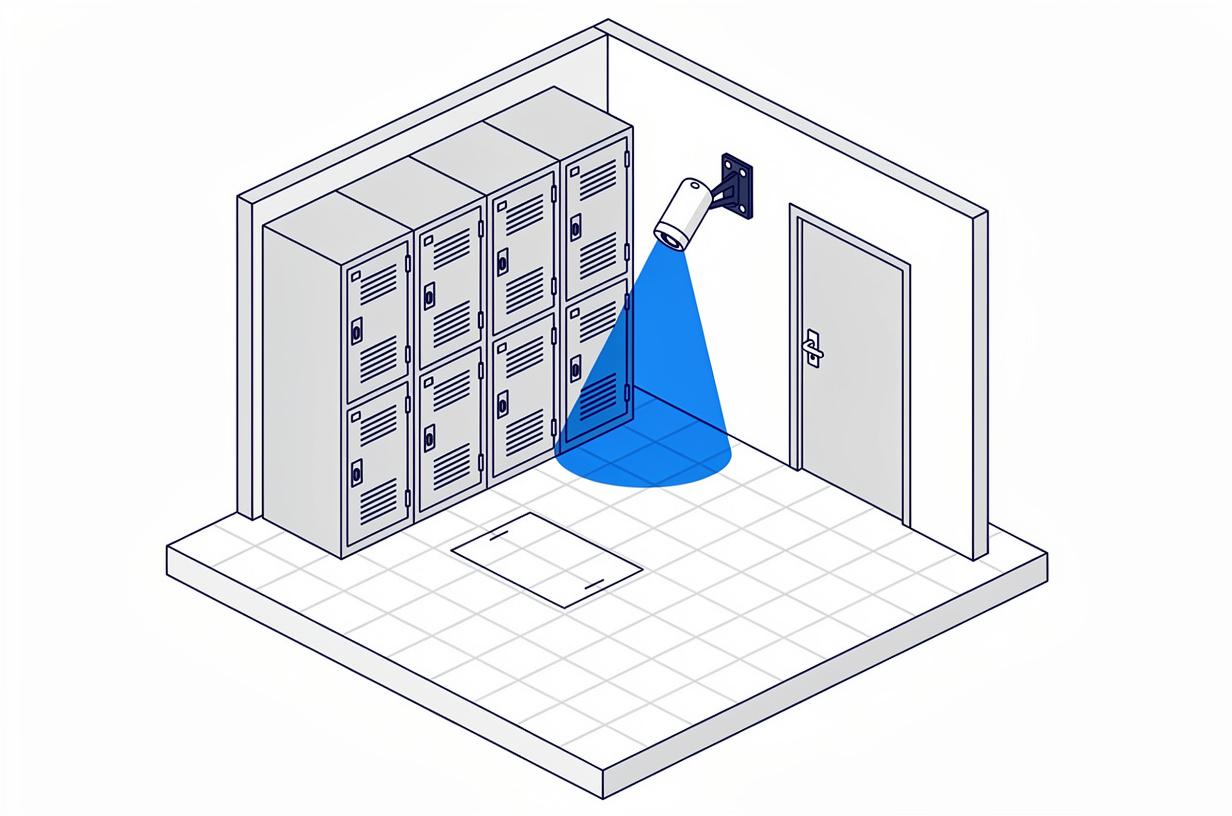
Table of contents
- The short version
- Where to place security cameras in a school
- Where cameras are not allowed
- FERPA: when footage becomes a student record
- Sharing video with law enforcement
- Integration with access control, panic alerts and vape detectors
- District-wide VMS and retention
- What security camera systems for schools cost
- Grant funding for school cameras
- Frequently asked questions
- Getting comparable quotes
Security cameras for schools are close to universal: NCES reports that 93% of public schools used them in 2021–22, up from 61% in 2009–10. The open questions for a district are narrower and harder. Which views actually matter, where recording is off limits, when a clip becomes a student record under FERPA, who outside the district can see it, and what the system costs to install and to keep running.
This guide works through those questions in the order a facilities director or administrator usually meets them. We don't install or sell cameras. We scope projects and match schools with licensed contractors for comparable quotes, so the figures below come from our published cost guides, federal guidance and district contracts on the public record.
The short version
- Placement: cover every exterior door, the secure vestibule, the bus loop and parking first, then interior common areas and corridor sightline breaks. Classrooms are rarely the priority.
- No-go areas: restrooms, locker rooms and changing areas. Audio recording is a separate legal question from video and is governed by wiretap law.
- FERPA: footage is an education record only when it is directly related to a student and maintained by the school. Students who appear only in the background are typically not the focus, so routine footage usually falls outside that test. The clip you pull for a discipline case usually falls inside it.
- Camera counts: we plan around 16 to 32 cameras for an elementary school and 60 to 120 for a middle or high school campus.
- Cost: most standard commercial IP cameras run $500 to $900 each installed, with a full range of $300 to $1,500. Cloud platforms add a per-camera licence every year.
- Funding: COPS SVPP is the main federal source for districts. E-Rate does not pay for cameras.
Where to place security cameras in a school
Federal and industry guidance agree on the general approach. CISA's K-12 School Security Guide treats CCTV as a detection measure inside a layered model: grounds, building perimeter, then interior. It also makes the point that a camera's value in an emergency depends on someone watching the feed in real time. The PASS Safety and Security Guidelines for K-12 Schools go further and set tiers. At Tier 1, PASS recommends fixed camera coverage of all common areas, including cafeterias, libraries, gymnasiums, theaters and places where students or parents interact with staff, such as the main office.
Our own rule for counting cameras is to start with the numbered exterior doors, bus loops, parking and interior sightline breaks, and not with a per-square-foot ratio. Cameras belong at doors, drives and blind corridors before they belong in every classroom.
| Area | What the view needs to do | Design notes |
|---|---|---|
| Main entrance and secure vestibule | Identify every visitor's face before the inner door releases | One camera on the approach, one inside the vestibule at face height, plus the video intercom. Watch for backlight from glass doors. |
| Other exterior doors | Show who came through a propped or forced door | One view per numbered door. Tie each to the door-held and door-forced alarm so the event is bookmarked. |
| Hallways and stairwells | Follow movement between spaces; cover blind corners | Place at intersections and stair landings looking down the corridor. Long corridors suit a corridor-format (vertical) view. |
| Cafeteria, gym, library, auditorium | Overview of large gatherings | Wide fixed or multi-sensor cameras. Overview quality is enough; pair with a tighter view at each exit. |
| Main office and nurse's corridor | Record interactions between staff and the public | Video in the public-facing area only. Keep exam and counseling rooms out of view. |
| Restroom and locker room entrances | Show who entered and when | Hallway side only, aimed so nothing inside is visible when the door opens. |
| Parking, drop-off and bus loop | Detect vehicles and people on approach | PASS notes large outdoor areas usually need only detection or recognition-level coverage unless the risk assessment says otherwise. Add a plate-capable view at drive entrances if you want plates. |
| Athletic fields and playgrounds | After-hours trespass and vandalism | Poles, trenching or wireless links can add significant cost per camera. |
| School buses | Student management on board; stop-arm violations outside | A separate mobile system. Decide up front how bus footage reaches the same retention and release process as building footage. |
One specification request separates a designed system from a counted one. Ask each bidder to show, on your floor plan, the pixels per foot they will deliver at each numbered exterior door. A camera that shows a blur at the door you care about is a camera you paid for twice.
Where cameras are not allowed
Restrooms, locker rooms and changing areas are off limits. Students and staff have a clear expectation of privacy there, and no retention or access policy fixes a camera placed in one. The same caution applies anywhere students change for athletics or theater, and we suggest keeping nurse's exam rooms out of view as well. This is why vape detectors, which have no camera, are the tool for restrooms. Our guide to vape detectors for schools covers how they pair with a hallway camera outside the door.
Audio is a different legal question
If any camera in the bid has a microphone, treat it as a separate decision. Recording conversations falls under federal and state wiretap law, and states differ on whether one party or every party must consent. Published state counts don't even agree with each other on which states are all-party, so treat this as a question for district counsel and have the installer disable audio by default. Put the audio setting for each camera in the as-built documentation.
Classrooms
General classroom cameras are a policy and labor-relations decision more than a security one, and our scoping puts cameras at doors, drives and blind corridors before classrooms. Special education is the exception in some states. Texas, for example, requires districts to install video and audio monitoring in certain self-contained special education classrooms under Education Code § 29.022, and the Texas State Library's school district schedule sets a three-month retention period for that footage. If your state has a similar statute, it will likely dictate audio, retention and who may view the recording, so check it before you write the scope.
FERPA: when footage becomes a student record
FERPA does not regulate cameras. It regulates education records. The U.S. Department of Education's FAQs on Photos and Videos under FERPA give a two-part test: a video is an education record when it is "(1) directly related to a student; and (2) maintained by an educational agency or institution or by a party acting for the agency or institution."
"Directly related" depends on context. The Department lists factors that point toward it:
- The school uses the video for discipline or another official purpose involving the student.
- The video shows conduct that would reasonably result in discipline, or a violation of law.
- The video shows a student "getting injured, attacked, victimized, ill, or having a health emergency."
A student who simply walks through the background is typically not the focus of the video, so thirty days of uneventful hallway footage that overwrites itself is generally not a pile of education records. The fight clip you export and attach to two discipline files is, and the Department says the same recording can be the education record of more than one student.
Parent requests and redaction
When a video is an education record for several students, a parent of any of those students generally has the right to inspect and review it, or be informed of its contents. FERPA generally does not require the school to hand over a copy. If the school can reasonably redact or segregate the portions directly related to other students "without destroying the meaning of the record," it must do so first. If it can't, the parents of each directly related student may still have access.
That rule has a procurement consequence. Ask every bidder to demonstrate masking a person and exporting a redacted clip in the VMS they are proposing, and ask what it costs. A district that has to send clips to an outside editor for every parent request will feel it in staff time.
The law enforcement unit exception
Records created and maintained by a school's law enforcement unit for a law enforcement purpose are excluded from the definition of education records (34 CFR § 99.8). The Department's FAQ on school resource officers and law enforcement units says a law enforcement unit can be any component the school designates to enforce laws or maintain physical security and safety. If that unit creates and maintains the surveillance video for a law enforcement purpose, FERPA does not stop it from disclosing the video to police. A copy handed to the assistant principal for discipline can become an education record again.
This is a governance choice with real effects, so write it down: which office owns the camera system, for what purpose, and who is designated as the law enforcement unit.
Sharing video with law enforcement
For recorded footage that is an education record, the Department is direct: a school may not turn it over to police on request without consent or an applicable exception. The exception most relevant to cameras is the health or safety emergency provision in 34 CFR § 99.36, which permits disclosure to appropriate parties when there is an "articulable and significant threat" and the school has a "rational basis" for its decision, judged on the totality of the circumstances.
An SRO can be treated as a "school official" with access to education records if the district has outsourced a function to them, they are under the school's direct control for the use of those records, and they follow FERPA's redisclosure limits. That means an SRO acting as a school official cannot pass the footage along to colleagues at the police department unless another FERPA basis applies.
Live access is less settled. We have not found Department guidance that squarely approves or prohibits giving police a standing live feed, and legal commentators disagree on how FERPA applies to live versus recorded video. PASS lists a memorandum of understanding with law enforcement for sharing video data among its districtwide best practices. A workable MOU usually answers four things:
- Trigger. Is access always on, or released only during a declared emergency or a panic alert?
- Scope. Which cameras, and live view only or playback and export too?
- Control. Does the district grant access through its own VMS with named user accounts, or does the agency hold credentials?
- Audit. Is every session logged, and who reviews the log?
Emergency-only triggers, district-controlled accounts and session logs each narrow the district's exposure, but none of them settles the legal question. Have counsel review the MOU against FERPA and state law before the integration is switched on.
Integration with access control, panic alerts and vape detectors
Cameras record what happened. Tied to other systems, they also tell staff where to look.
- Access control. Door-forced, door-held and denied-badge events should bookmark the nearest camera and pop its view at the front office. CISA describes this kind of layering, where detection in one layer triggers door locks and lockdown measures in the next. A standard controlled opening runs $1,500 to $3,500 per door installed, and school lockdown integration adds $500 to $1,500 per door.
- Panic alerts. When a panic alert fires, the VMS should surface cameras near the activation and, if your MOU allows, release them to responders. Thirteen states have enacted a version of Alyssa's Law as of November 2026 by our count, and trackers differ on what counts as a version. Some laws mandate panic alerts and others only require schools to consider them, so check your state's text. Wearable panic systems typically cost $8,000 to $25,000 per school plus an annual subscription.
- Vape detectors. The sensor sits in the restroom and has no camera. The alert bookmarks the hallway camera outside the door, which narrows review to whoever left in the next minute. Detectors often price at $1,100 to $2,100 each installed and licensed.
- After-hours intrusion. Video verification of an alarm lets a monitoring center confirm a person is in the building before dispatch. PASS places this at its higher tiers.
Integration is where proprietary platforms pay off and where they lock you in. Ask whether each link is a native integration, an open standard or custom work that breaks with the next firmware update. Our integrator vendor scorecard covers what to get in writing: ONVIF-conformant cameras, district-held admin credentials and licence keys, and documented archive export.
District-wide VMS and retention
PASS recommends that districts standardize both cameras and recording systems and adopt a written video use and data retention policy. In practice, one VMS across every campus means one set of user roles, one export procedure for records requests and one platform for the district office or police to learn. The trade-off is commitment to a single vendor's licensing.
| On-premises NVR or server | Cloud-managed platform | |
|---|---|---|
| Recurring cost | Can be $0 a month; drives and servers are replaced on a cycle | $10 to $30 per camera per month for 30-day retention at 1080p to 2K |
| Longer retention | Add drives at $20 to $80 per TB | $30 to $60 per camera per month for 4K or 60 to 90 days |
| Multi-campus access | Needs VPN or a federated VMS and IT time | Built in, with central user management |
| If you stop paying | System keeps running | Depends on the vendor. Verkada cameras, for example, keep recording but lose Command access 30 days after licence expiry |
| Camera choice | Usually open (ONVIF) | Often the vendor's own cameras only |
How long to keep footage
Set the retention policy before anyone sizes a recorder. Our working range for schools is 14 to 45 days unless state law or your insurer says otherwise. Thirty days is common in state schedules: Florida's general records schedule for state and local agencies lists surveillance recordings at 30 days, and the Georgia Archives schedule sets 30 days for surveillance video with no known incident and holds incident footage until claims are settled. Texas's school district schedule keeps bus video tied to an incident until 30 days after the incident is resolved or a verdict is rendered, and urges at least ten school days for routine bus video.
Two points get missed. First, routine retention and incident retention are different clocks. Any clip tied to discipline, an injury, a claim or a records request needs a hold procedure that takes it out of the overwrite cycle. Second, retention drives storage cost. Our video surveillance buying guide sizes storage at roughly 1 TB per camera per month at 1080p and about 2 TB at 4K, with 20 to 50 percent headroom. A 100-camera high school at 30 days and 1080p needs about 100 TB before headroom.
What security camera systems for schools cost
Our security camera installation cost guide puts installed pricing at $300 to $1,500 per camera, with most standard commercial IP cameras landing at $500 to $900. Labor is $100 to $300 of that. Applying the $500 to $900 band to our planning counts gives a starting budget for cameras, cabling and labor:
| School | Our planning count | Cameras installed at $500–$900 each | Cloud licences at $149–$219 per camera per year |
|---|---|---|---|
| Elementary | 16 to 32 | $8,000 – $28,800 | $2,400 – $7,000 a year |
| Middle or high school campus | 60 to 120 | $30,000 – $108,000 | $8,900 – $26,300 a year |
These rows are arithmetic on our published ranges, not quotes, and they sit at the low end of what schools are told elsewhere. Some installers design denser coverage and price higher: one published estimate puts a 60,000-square-foot elementary school at 50 to 65 cameras and a 150,000-square-foot high school at 100 to 130. If two bids differ by a factor of two on camera count, the floor plan is where you find out why. Real bids also move above the band for multi-sensor and plate-capture cameras, exterior poles and trenching, new network switches, asbestos or hard-ceiling buildings, and work restricted to nights or summer. The licence column uses published one-year list prices: Rhombus at $149 or $199 per camera per year and Verkada at $219. Avigilon Alta's price list shows $179 MSRP for a one-year per-camera subscription with 30 days of cloud storage. Multi-year terms lower the annual figure.
District contracts on the public record come in higher per camera than that band:
- Garfield Re-2 in Colorado approved nearly $900,000 for more than 400 cameras across eight schools.
- Chico Unified in California signed a $1.9 million contract covering 691 camera locations.
Chico's contract works out to roughly $2,750 per camera location and Garfield Re-2's to a little over $2,000 at most. The public summaries don't break out hardware, licences and labor, which is exactly the breakdown to demand in your own bids.
Cameras are also one line in a larger project. Our school security systems page gives whole-project planning ranges that include controlled doors, a secure vestibule, classroom locksets and panic alerting: $50,000 to $150,000 for a single elementary school, $150,000 to $500,000 for a middle or high school campus, and $750,000 to $5,000,000 for a district of 8 to 20 campuses. It also covers state mandates and the rest of the scope.
What to require in every bid
- Camera make and model for every location, marked on the floor plan, with pixels per foot at each exterior door.
- Retention in days, and the storage calculation behind it.
- Licence cost per camera for years one through ten, and what happens to recording and access if a licence lapses.
- Who owns the cameras, recorders and admin credentials at the end of the term.
- Redaction and export capability, demonstrated.
- Whether existing cable and cameras can be reused. Our analog-to-IP upgrade guide covers the retrofit paths.
Grant funding for school cameras
| Program | Who can apply | Key terms | Cameras? |
|---|---|---|---|
| DOJ COPS School Violence Prevention Program (SVPP) | Districts and other government applicants. Individual schools and private schools cannot be the primary applicant. | Up to $500,000 per award over 36 months, 25% local cash match unless waived. Up to $73 million anticipated in FY26. | The federal program aimed at security equipment and technology. Confirm eligible items in the current notice. |
| BJA STOP School Violence | Districts, nonprofits and, in one category, private K-12 schools | Award ceilings of $1 million to $2 million, no match | No. It funds training, threat assessment and reporting tools, and its notice sends equipment requests to SVPP. |
| FEMA Nonprofit Security Grant Program | Nonprofit organizations at high risk of terrorist attack. It is the main federal security grant route for nonprofit private schools. | $300 million in FY 2026, split evenly between the Urban Area and State programs | FEMA describes the funding as support for target hardening and other physical security enhancements. Confirm eligible items in the current notice. |
| Stronger Connections Grant (Bipartisan Safer Communities Act) | High-need districts, through competitive subgrants from the state education agency | $1 billion provided to states under Title IV-A safe and healthy students activities | Not settled at the federal level in anything we have found. Ask your state education agency whether cameras are allowable. |
| State programs | Varies | Texas, for example, funds a school safety allotment of $10 per student in average daily attendance plus $15,000 per campus | Often yes. Texas lists cameras among eligible uses. |
| E-Rate | — | — | No. USAC's eligible services training states that bus security cameras are ineligible, and the FCC's cybersecurity pilot list excludes security cameras. |
The FY26 SVPP window closed in August 2026 and FEMA announced FY 2026 NSGP awards on September 28, 2026, so both are planning items for the next cycle. Use the gap to get a site assessment and a costed scope done, since a grant application with real quantities and prices is far easier to write.
If federal grant or loan money touches the project, 2 CFR 200.216 and Section 889 of the FY2019 NDAA bar covered equipment, including Hikvision and Dahua cameras. Check state purchasing restrictions and your grant terms too. Write "NDAA-compliant" into the scope and require camera and recorder brands in every bid. Our upgrade guide explains how the rule applies to schools.
Frequently asked questions
Is school security camera footage protected by FERPA?
Only when it is an education record, meaning it is directly related to a student and maintained by the school or a party acting for it. Footage a school uses for discipline, or that shows a student being injured or breaking a rule or law, usually qualifies. Routine footage where students are incidental generally does not. Footage created and maintained by the school's law enforcement unit for a law enforcement purpose is excluded.
Can a parent watch footage that shows other students?
Yes, if the video is directly related to their child. The school must first redact or segregate other students where it reasonably can without destroying the meaning of the record. If it can't, the parent may still inspect the video. FERPA generally does not require the school to give the parent a copy.
Can schools put cameras in classrooms?
It is a matter of district policy and state law. Our scoping puts cameras at doors, drives and blind corridors before classrooms. Some states have specific statutes for self-contained special education classrooms. Texas is one, with video and audio required in certain settings and a three-month retention period.
Can a school give police live access to its cameras?
There is no clear federal rule either way, so districts handle it through a memorandum of understanding. Releasing access only during an emergency or panic alert, running it through district-controlled accounts and logging every session all narrow the exposure. Have district counsel review the arrangement against FERPA and state law.
How many cameras does a school need?
We plan around 16 to 32 for an elementary school and 60 to 120 for a middle or high school campus. Count from the floor plan: each exterior door, the vestibule, bus loop, parking, large common spaces and each corridor sightline break.
How long should a school keep surveillance footage?
We usually recommend 14 to 45 days unless state law or your insurer says otherwise, and 30 days appears in several state records schedules. Check your state's schedule and your insurer's requirements, and keep a separate hold procedure for any clip tied to an incident, claim or records request.
Getting comparable quotes
Camera bids for schools are hard to compare because each contractor counts differently, proposes a different platform and buries licence terms in a different place. If you want a second or third number on the same scope, send us your building profile. We match it with a small number of state-licensed, insured contractors with K-12 experience, and you see who they are before anyone calls. Contractors pay us for the introduction, so there is no fee and no obligation for the school. How it works has the details on screening.
Ready to get started?
Talk to our team and see how we can help.