Vape Detectors for Schools: How HALO and Its Rivals Work, What They Cost, and the Privacy Rules
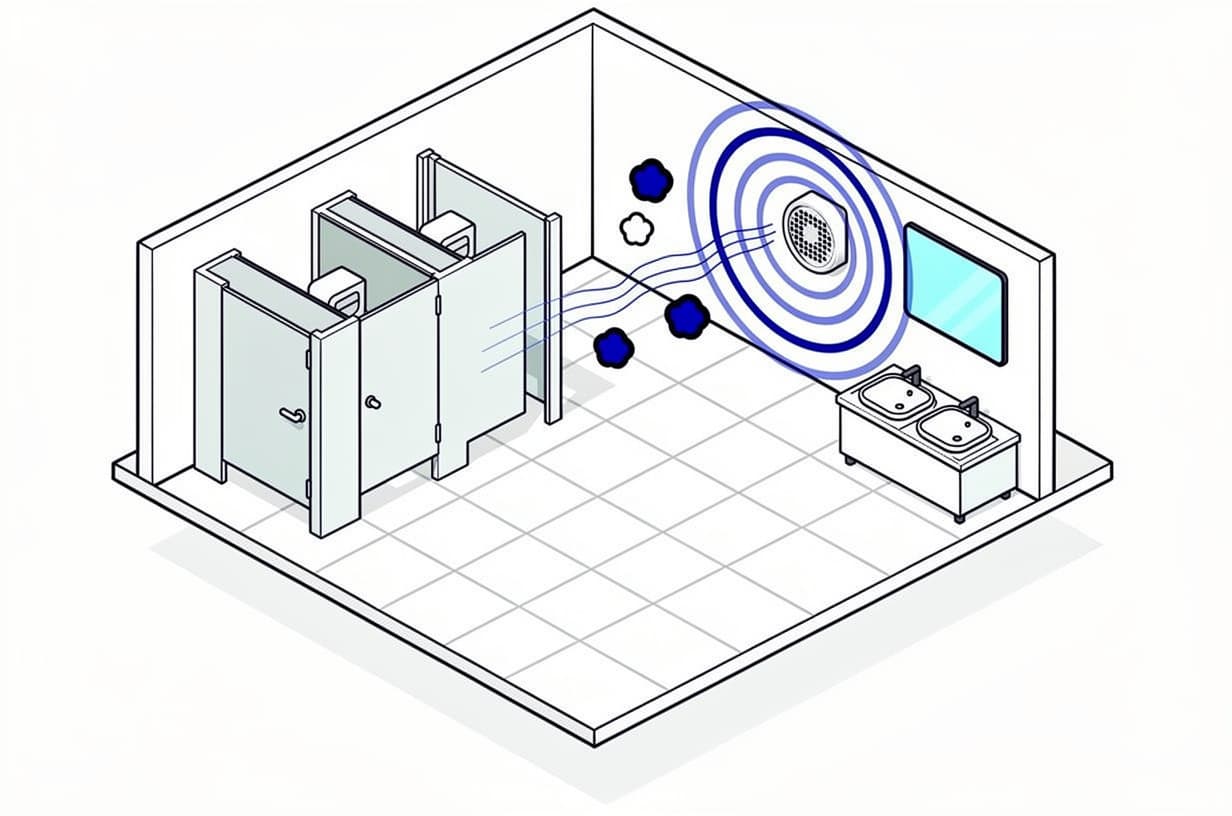
Table of contents
- Why schools are buying them
- How vape detectors work
- What a HALO vape detector detects, and what it does not
- How alerts reach staff
- Integrating with cameras and access control
- Privacy rules for restrooms and locker rooms
- What vape detectors cost
- Do they work? Effectiveness and false alarms
- How to compare vape detector vendors
- Frequently asked questions
Vape detectors solved a problem that cameras legally cannot: how to know what is happening in a school restroom without watching it. The devices are ceiling-mounted sensors, roughly the size of a smoke detector, that sample the air for vape aerosol and THC signatures and text or email a staff member when they find them. The HALO vape detector from Motorola Solutions (originally IPVideo Corp) is the product most administrators have heard of, but it now competes with Triton, Verkada, Soter FlySense and Zeptive, and the differences between them in sensors, alerting, audio handling and recurring fees are large enough to change both the budget and the privacy conversation with your board.
This guide covers how the sensors actually work, what they can and cannot tell you, how to wire them into the cameras and access control you already have, the privacy rules that apply in restrooms and locker rooms, what districts are really paying per unit, and how to get vendor quotes you can compare line by line.
Why schools are buying them
Youth vaping has fallen from its peak but has not gone away. The CDC's 2024 National Youth Tobacco Survey found 5.9% of middle and high school students, about 1.63 million, had used e-cigarettes in the past 30 days, still the most commonly used tobacco product among students. Restrooms and locker rooms are where enforcement is hardest, because they are spaces where cameras are not permitted.
Two things pushed detectors from pilot projects to standard procurement. The first was money: districts received settlement payments from Juul Labs, and NPR reported in 2024 that districts from Spokane to Orlando to Lincoln, Nebraska were spending those funds on detectors. The Texas Education Agency's Title IV, Part A FAQ confirms districts may use that ESSA grant for vape detectors, prevention tools and education programs under Section 4108, provided local policy does not already require the sensors, which would make the purchase supplanting. The second was discipline law. Texas HB 114, effective September 1, 2023, made DAEP placement mandatory for e-cigarette possession, which meant every incident needed documentation. HB 6 in 2025 softened that: TEA's guidance confirms DAEP placement for e-cigarettes is now discretionary, but a first-time offender not sent to DAEP must serve at least ten school days of in-school suspension. Either way, a defensible record of when and where the incident occurred matters, and that is what a detector log provides.
How vape detectors work
There is no single "vape sensor." Every product on the market is a bundle of environmental sensors plus firmware that decides when the readings add up to a vaping event. Three approaches are in use:
- Particulate sensing. A particle sensor watches for the sudden spike in fine aerosol that an exhaled vape cloud produces. It is cheap and fast, but hairspray, body spray and steam produce particles too. Simpler devices such as the TAKEX VS-1000E work this way and report through a dry-contact relay rather than a cloud platform.
- Chemical (VOC) sensing. Gas sensors read volatile organic compounds, and vendors calibrate against the chemical signatures they associate with nicotine e-liquid and, separately, with THC vapor. Triton, for example, describes its sensors monitoring for the specific chemical signatures of nicotine and THC emissions, which is how a device can flag "THC" as a distinct event.
- Hybrid sensing. HALO, Triton, Zeptive and Verkada combine multiple sensor types, and HALO documents that the event decision is made on the device itself. Zeptive describes particle and chemical sensors sampling together to identify aerosol patterns associated with nicotine vaping, THC vaping and smoke. Hybrid logic is what keeps a can of deodorant from looking like a vape hit, most of the time.
The better units add microphones for sound-level analysis. HALO uses two MEMS microphones for audio analysis only, listening for the acoustic pattern of shouting or a fight, or for a spoken emergency keyword, without storing audio. That distinction, analyzing sound versus recording it, is the whole legal argument for putting the device in a restroom, and we come back to it below.
Most current models are powered over Ethernet; Zeptive also offers battery and Wi-Fi configurations, and the TAKEX unit runs on low-voltage DC. The HALO 3C runs on a standard 802.3af PoE port, so each sensor needs a Cat6 home run to a PoE switch, exactly like an IP camera. If your restrooms have no network drops, cabling will be a real line item in the quote. Our camera installation cost guide puts cable runs through accessible ceilings at $50 to $200 per camera and PoE switches at $100 to $1,500, a reasonable benchmark for detector drops as well.
What a HALO vape detector detects, and what it does not
HALO is the reference point most districts compare against, so it is worth being precise about what it does. The current generation is the HALO 3C, with a 3C-PC variant that adds people counting. Across the Avigilon datasheet and reseller specifications, the device reports:
- Vaping, and vaping with THC, as separate event types
- Aggression (loud, abnormal noise in a normally quiet space) and gunshot detection
- Spoken emergency keywords and an optional physical panic button
- Air quality: CO2, particulates, humidity, VOCs and NO2, with custom options for gases such as ozone and hydrogen sulfide
- Tamper (the device being covered, struck or removed) and motion for after-hours trespass
- Occupancy and people counting on the 3C-PC
Detection and the health/air-quality index are processed on the device; events are then pushed to HALO Cloud for notifications, dashboards and multi-site management. The HALO administrator manual states the unit is designed to prohibit direct monitoring or recording of video or audio.
What it does not do is identify a student. A detector tells you a vaping event occurred in the second-floor boys' restroom at 10:42. Figuring out who was in there is a staff and camera workflow, not a sensor function. Any vendor who implies otherwise is overselling.
How alerts reach staff
Alerting is where deployments succeed or fail. Every platform can send a text and email the moment a threshold is crossed; the question is who gets it and what they do in the next ninety seconds. Districts that report results, such as Lincoln Public Schools, which went from nearly 100 alerts in its first week to four by winter break, pair the alert with an assigned responder on each floor and a documented search-and-consequence procedure. Detectors with no one responding become expensive air-quality monitors within a semester.
Practical configuration points to settle before installation:
- Recipient groups by time of day. Assistant principals during passing periods, custodial or SRO staff after hours, nobody at 2 a.m. unless it is a tamper or gunshot event.
- Threshold tuning per room. A locker room next to showers runs humid; a small single-stall restroom concentrates aerosol fast. Vendors expose sensitivity settings per device, so plan for an initial tuning period before alerts carry disciplinary weight.
- Coverage area. Verkada's own guidance states its sensors detect vaping within roughly 250 square feet, or an 8-foot radius on an 8-foot ceiling, with accuracy dropping on higher ceilings. Large locker rooms need more than one device, and the vendor's walkthrough, not a floor-plan count, should decide how many.
- Escalation. Tamper alerts and keyword/aggression events should route differently from vape events. A covered sensor is itself evidence.
Integrating with cameras and access control
The most useful configuration treats the detector as an event source for the security system you already run. The cameras stay in the hallway, where they belong; the detector supplies the timestamp.
Video. A vape alert bookmarks the hallway camera covering the restroom door, so staff can review who entered in the minutes before the event. HALO has native integration with Avigilon Unity, is a certified device in the Genetec Industrial IoT plugin (which carries its own license), and works with OpenEye and Milestone XProtect. Note that the Milestone path adds the sensor as a hardware device, consuming a device license per unit, unless you use third-party middleware. Triton lists more than 20 integrations including Genetec, Milestone, Avigilon, Verkada and Hanwha; Zeptive connects to Genetec via MQTT and to Axis cameras. Verkada's SV sensors live natively inside Verkada Command alongside its cameras.
Access control. Where restroom corridors or locker rooms have card readers, a detector event can be correlated against badge logs, and HALO's BACnet support lets facilities teams push air-quality data to building automation. Our guide to integrators who install access control and CCTV together explains why a single contractor should own the event-to-video programming; a vape detector is one more event type on the same list.
Ask the integrator to document which platform fires the notification, which one stores the event log, and who holds admin credentials. Districts that let the detector vendor, the VMS vendor and the IT department each assume someone else configured the integration end up with alerts that go nowhere.
Privacy rules for restrooms and locker rooms
Detectors exist because cameras in restrooms are a non-starter under state voyeurism and privacy statutes (Minnesota's § 609.746 is a typical example). The sensors are marketed as the compliant alternative. Four issues still deserve a line in board policy.
Audio analysis versus audio recording
Federal wiretap law and the all-party-consent statutes in states such as California, Illinois, Florida and Washington turn on interception of oral communication. A device that computes a decibel level or matches a keyword on-chip and never stores or transmits audio is on far firmer ground than one that keeps recordings, though the question is not fully settled: some legal commentary argues that a device capable of capturing audio may "intercept" even when nothing is stored, so get the vendor's audio handling in writing and in front of counsel. HALO, Triton Pro and Zeptive all state they do not record audio. Verkada's SV25 is different: its pricing page notes the SV25 retains audio for 90 days. That may be acceptable in a hallway; in a restroom it is a question for district counsel before purchase, not after.
Student privacy advocates object to the premise
The ACLU has argued that the surveillance posture of detectors undermines student trust in teachers and administrators, and the American Lung Association warns that detectors without education and cessation programs simply move the problem. Expect these arguments at the board meeting and have the response policy, not just the hardware, ready to present.
FERPA and the alert log
A sensor log by itself contains no student information. The moment an alert is linked to a named student in a disciplinary file, together with the hallway video used to identify them, the record becomes an education record. The U.S. Department of Education's guidance is explicit that surveillance video used for disciplinary action is directly related to the students involved and subject to FERPA, including parents' right to inspect it and the school's obligation to redact other students where feasible. Set retention for detector logs and associated clips deliberately, and restrict cloud dashboard access to staff with a disciplinary role. Our school security guide covers the FERPA treatment of footage and retention decisions in more depth.
Searches after an alert
An alert is not proof. Verkada says plainly that its Vape Index cannot provide 100% proof of a vaping incident, and NPR documented a Lincoln student pulled out and searched after spray deodorant triggered a sensor. Your search policy should treat the alert as reasonable suspicion to investigate, and the investigation, not the alert, as the basis for discipline.
What vape detectors cost
Hardware runs from roughly $650 to $1,800 per unit depending on brand and model, with most school purchases in the upper $700s to mid $1,600s. The installed, licensed, per-unit figure districts actually pay is often closer to $1,100 to $2,100. The gap is cabling, labor, activation and the cloud subscription, which is why a hardware quote alone tells you very little.
| Product | Hardware price (per unit) | Recurring cost | Audio handling |
|---|---|---|---|
| HALO 3C / 3C-PC | $1,495 / $1,795 list; $1,405 / $1,687 on one public contract; Chicago Public Schools paid $937.95 for the 3C at volume | HALO Cloud $139 for one year, $385 for three, $587 for five | Analysis only, no recording |
| Triton (base / Pro / Ultra) | $899 / $1,195 / $1,495 MSRP | Pro and Ultra include a 10-year cloud license and warranty | No cameras or audio (Pro); Ultra adds keyword and aggression analysis |
| Verkada SV23 / SV25 | $999 / $1,299 MSRP | Verkada Command license required, priced separately | SV25 retains audio 90 days |
| Soter FlySense FS300 | No public list price; reseller pricing varies by model | $120 per device per year support plan | Sound-level analysis for aggression |
| Zeptive (wired / wireless) | No published list price; one K-12 IT administrator reported about $1,200 | About $35 per year support, per the same single report | Optional sound-level monitoring, no recording |
Real projects show how the pieces add up. Montgomery ISD in Texas approved about $49,000 for 23 HALO sensors across six restrooms at two high schools, which local reporting put at roughly $2,000 each including installation, activation and licensing. Bangs ISD reported paying about $1,100 per sensor. An analysis of 1,225 K-12 vape detector contracts found a median contract value of $14,204, consistent with limited initial deployments or phased rollouts rather than full district coverage.
Budget lines to insist on seeing separately in every quote:
- Hardware, by model number, with the people-counting or panic-button variant called out
- Cloud or software license, with the term in years and the renewal price after the included period
- Cat6 cabling and any PoE switch ports or switch upgrades
- Installation and configuration labor, including after-hours or summer rates
- VMS or access-control integration, including any third-party plugin or per-device license
- Training, warranty term and service response commitment
A ten-year Triton license priced into the hardware and a HALO Cloud license bought in one-, three-, five- or ten-year terms are not comparable until you lay both out over the same period. Our standardized quote-comparison checklist walks through normalizing subscriptions and ownership across bids, and the same method works here.
Do they work? Effectiveness and false alarms
The evidence is mostly district self-reports and vendor case studies, so treat the numbers as directional. Collier County Public Schools in Florida saw an 80% drop in alerts over a pilot year; Lincoln's 100-to-4 trajectory is above. Triton's own case studies claim declines of 80% to 83% within 10 to 16 weeks, and its 2026 accuracy report cites 98.9% observed accuracy across 8,400 logged events while acknowledging that results vary with mounting height, airflow and room geometry. Motorola's head of HALO sales told NPR the system is 93% accurate. None of these figures come from independent evaluation.
Three failure modes recur in district experience:
- Aerosol false positives. School officials told NPR they see false positives from substances such as perfume, and Triton reports districts seeing false alerts from aerosol deodorants, hairspray, high humidity and cleaning chemicals. Hybrid chemical sensing reduces but does not eliminate them, which is why the alert should trigger an investigation rather than an automatic consequence.
- Evasion. Students exhale into bottles, sleeves or toilets. Per Motorola, this mostly delays detection because the aerosol still reaches the sensor, but it does lengthen the window between event and alert.
- Tampering and vandalism. Expect it. Specify tamper alerts, mount above easy reach, and treat a covered or damaged unit as a disciplinary event in its own right.
The detector supplies the information; it does not change behavior on its own. Pair it with a published, consistently applied response and, as the American Lung Association urges, with education and cessation support.
How to compare vape detector vendors
Because these devices are typically installed and integrated by security contractors, in practice you are comparing installers as much as products. The questions that separate a good bid from a bad one:
- Which platform do we already run? If your cameras are Avigilon or Genetec, HALO's native integrations are a strong argument; if you are a Verkada campus, the SV series lives inside the same Command platform; if you are on Milestone, factor in the per-device license.
- What does the license actually unlock? HALO Cloud is required for real-time notifications, analytics and multi-device management. Ask what the device does on the day the subscription lapses.
- Audio posture. Get it in writing: does the device record, buffer or transmit audio under any setting?
- Data residency and access. Who can see the dashboard, where the logs live, how long they are retained, and whether the contract has a FERPA-appropriate data clause.
- K-12 references and credentials. Manufacturer training certificates for the specific product, named district references, and the background-check and badging requirements your district imposes on anyone working in student areas. Our guide to school security installers lists what to ask.
- A site walk before a number. Sensor count depends on ceiling height, airflow and restroom layout. A quote produced from a floor plan alone will be wrong in one direction or the other.
Getting two or three integrators to price the same scope is the only way to see whether a $1,400 sensor on one bid and a $950 sensor on another reflect different products, different license terms or just different margins. That is the gap we exist to close. We do not sell or install detectors; we scope the project with you, route the same specification to licensed and insured contractors with K-12 experience in your area, and you get back comparable quotes showing installed cost, recurring fees, contract terms and equipment ownership, at no cost to the district. If you are budgeting a restroom sensor project alongside cameras or access control, you can start a school quote request here.
Frequently asked questions
Can a vape detector tell the difference between nicotine and THC?
Hybrid sensors from HALO, Triton and Zeptive report vaping and THC as separate event types based on the chemical signature of the aerosol. The distinction is useful for discipline tiers, where a code of conduct treats cannabis more severely, but it is a sensor classification, not a laboratory result, and should be confirmed by what is found in the investigation.
Do vape detectors record audio or video?
The school-market detectors covered here have no cameras. HALO, Triton Ultra and Zeptive analyze sound levels or keywords on the device without recording audio; Triton Pro has no audio at all. Verkada's SV25 retains audio for 90 days according to Verkada's pricing documentation, so confirm the audio posture of any model before placing it in a restroom.
How many vape detectors does a school need?
Plan per restroom and locker room, not per campus. Verkada's guidance puts single-sensor coverage at about 250 square feet on an 8-foot ceiling; larger locker rooms and high ceilings need more units. For scale, Montgomery ISD used 23 sensors for six restrooms at two high schools, and another district proposed 27 for its high school restrooms.
What does the HALO vape detector cost?
Public contract pricing for the HALO 3C runs from about $940 at large-district volume to roughly $1,400 on standard cooperative contracts, with the people-counting 3C-PC near $1,700, and the HALO Cloud license at about $139 per year or $385 for three years. Districts have reported about $1,100 per sensor (Bangs ISD) up to about $2,000 installed, activated and licensed (Montgomery ISD).
Are vape detectors legal in school bathrooms?
Devices that sense air quality and sound level without recording video or audio are widely deployed in restrooms and are marketed specifically for that use. Legality turns on state recording-consent and privacy law and on how the district handles alerts and any linked video under FERPA. Have counsel review the specific model's audio handling and the district's search and retention policy before installation.
Can a vape detector be funded with grant or settlement money?
Districts have used Juul settlement proceeds for detectors, and the Texas Education Agency's Title IV, Part A FAQ lists vape detectors as an allowable use of that ESSA grant as long as the purchase supplements rather than supplants locally required spending. Eligibility under other state and federal programs varies by solicitation, so confirm with the granting agency before committing funds.
Ready to get started?
Talk to our team and see how we can help.