Security System Integrator vs Managed Security Contract: 5-Year Cost of Owning vs Bundling
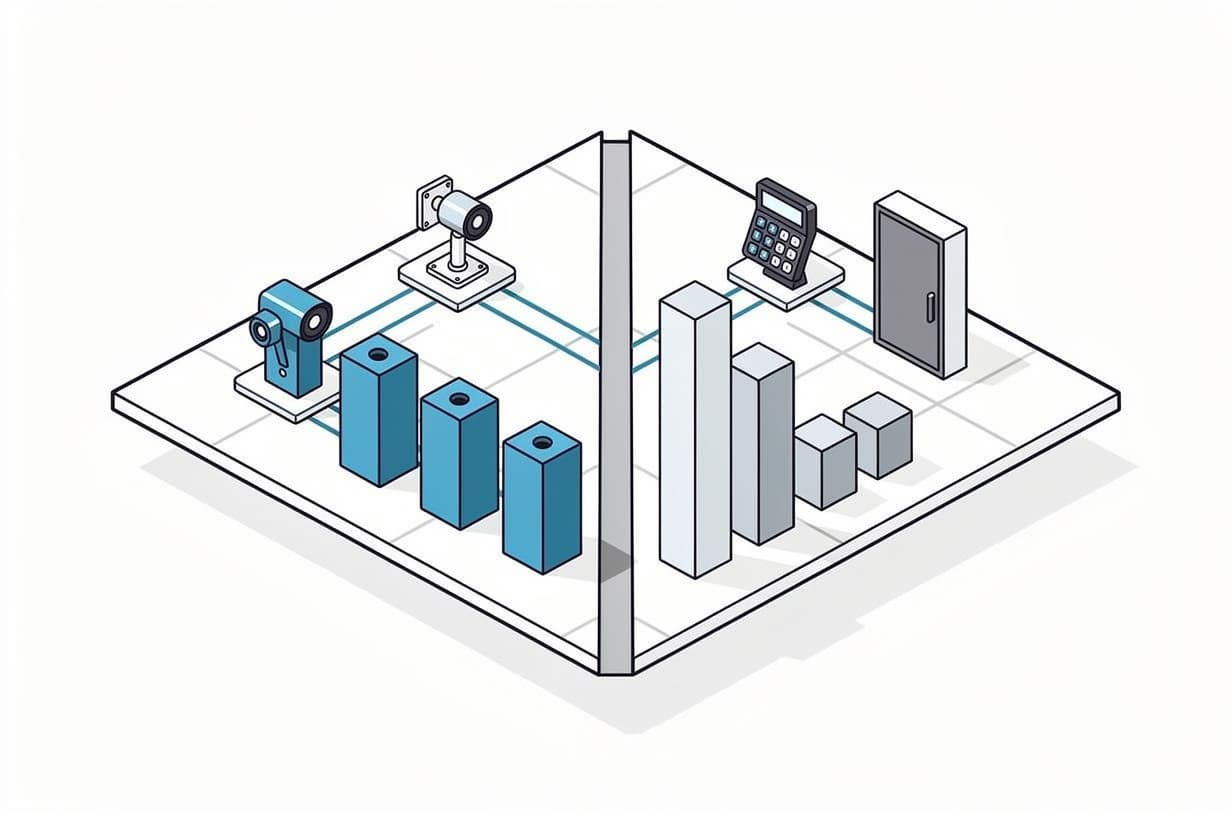
Table of contents
- What "end to end" actually includes
- Security system integrator vs managed provider vs local installer
- Commercial security systems companies that do it end to end
- The 5-year cost math: bundled managed fee vs owned system
- Who owns what when the contract ends
- Getting out: renewal windows, termination and takeovers
- When managed is the right call, and when owning wins
- Multi-site checklist for security companies for business
- How to compare a bundled fee with an itemized quote
- Frequently asked questions
The companies that install and manage business security systems end to end are national managed-service providers and large security integrators: Everon (formerly ADT Commercial), Securitas Technology, Johnson Controls, Convergint and Vector Security. Each covers the full lifecycle under one contract: assessment, design, equipment, installation, integration, 24/7 monitoring, maintenance and upgrades. A good local security system integrator can deliver the same lifecycle for a single building, usually with the system sold to you outright and monitoring priced separately. The catch with any bundle is that one monthly fee hides the two things that decide what you actually paid: who owns the hardware at the end of the term, and what it costs to leave.
This guide is about that buying-model decision, not about which brand of camera to pick. We run a free quote service that puts licensed local contractors' pricing side by side for businesses; we do not install, monitor or sell equipment, and contractors pay us for the introductions. That lets us publish the one comparison a provider page cannot: a worked five-year total for a bundled managed contract against an owned system with monitoring and service bought separately, with every assumption labelled.
What "end to end" actually includes
Managed commercial security means one provider is contractually responsible for the system from design through replacement. Everon describes its model as installation, integration, monitoring and lifecycle maintenance; Securitas Technology lists system design, installation, integration, interactive monitoring, preventative maintenance, remote and managed services. The lifecycle breaks into eight stages, and each one becomes a line item (or gets buried in one) on the quote:
- Assessment and risk survey: often bundled into a managed proposal; sometimes a design fee from a local integrator on large projects.
- Design and engineering: drawings, device schedules, fire code review. A "design/engineering" line or absorbed into labor.
- Equipment: itemized on an owned quote; subsidized, financed or leased inside a managed fee.
- Installation: labor, cabling, lifts, permits. Itemized at $75 to $150 an hour for a low-voltage crew on an owned quote.
- Integration and commissioning: programming, testing, training. Often a separate labor line.
- 24/7 monitoring: the recurring line that drives contract length.
- Maintenance and service: a service plan on an owned system; included in a managed fee, subject to the exclusions listed in the agreement; read that list.
- Upgrades and refresh: the item to ask about explicitly, because neither kind of quote has to show it.
Security system integrator vs managed provider vs local installer
The three terms get used interchangeably by vendors, but they describe different commercial relationships. A security system integrator designs and installs systems built from multiple manufacturers' products and makes them work as one; it may or may not monitor, and it usually sells you the hardware. A national managed-security provider wraps installation, monitoring and service into one recurring contract, often retaining ownership of some or all of the equipment. A local licensed installer sells and installs the system, and either monitors through its own or a contract central station, or leaves you free to buy monitoring elsewhere. Everon, Securitas Technology and Convergint are integrators that also operate as managed providers; many local firms are integrators that do not.
| Model | Who installs | Who monitors | Who services | Who owns hardware | Typical term | Typical customer | How pricing is shown |
|---|---|---|---|---|---|---|---|
| National managed provider | Provider's technicians or subcontractors | Provider's own UL-listed centers | Provider, under the same contract | Often the provider until term end or buyout; varies by contract | 36 to 60 months, auto-renewing | Single sites up to national multi-site accounts | Low upfront plus one bundled monthly fee |
| Enterprise security integrator | Integrator | Own center, partner center, or customer's choice | Integrator under a service agreement | Usually the customer | Project contract plus separate service and monitoring agreements; one published Securitas Technology proposal ran five years, billed quarterly in advance | Mid-size to enterprise, multi-site, campus | Itemized project price, separate recurring lines |
| Local licensed installer plus separate monitoring | Local contractor | Contract central station or any station you choose | Local contractor, per call or on a plan | The customer | 36 to 60 months monitoring, often auto-renewing; service plan optional | Single site and small regional portfolios | Itemized installed price, monthly monitoring rate, optional service plan |
Commercial security systems companies that do it end to end
A short segmentation first, because it is how the market actually sorts: a local integrator or a national package works for a small single site; Everon, Securitas Technology or Convergint fit mid-size and multi-site programs; Johnson Controls fits where security has to tie into building automation.
Everon (formerly ADT Commercial)
Everon is the former commercial fire and security segment of ADT, acquired by private equity firm GTCR in a deal that closed in October 2023 with more than 5,000 employees and over 300,000 customer locations, then rebranded. It offers intrusion, access control, video, fire and life safety, its own monitoring centers, and a managed services and national account program. Suits: multi-site commercial real estate, retail, healthcare, banking and other enterprise accounts that want one national contract. It does not publish commercial pricing.
Securitas Technology (formerly STANLEY Security)
Launched in 2022 when Securitas AB acquired STANLEY Security, Securitas Technology reports more than 5,000 technicians and over a million client sites worldwide, and can bundle guarding and remote services from the parent company. Its published general terms state that equipment, software and documentation supplied by Securitas remain its property unless agreed otherwise in writing, which is exactly the clause this guide is about. Suits: multi-site retail, financial, commercial office and data-center programs that want technology and guarding under one roof.
Johnson Controls
Johnson Controls owns the Tyco, Software House, Kantech, Exacq, American Dynamics and DSC product lines and sells security as part of its OpenBlue building platform alongside HVAC, controls and fire. Suits: institutional and large commercial buildings where access control, video and intrusion need to share a platform with building automation, or where the fire and HVAC contracts are already with JCI.
Convergint
Convergint is an independent integrator founded in 2001, named SDM's top systems integrator for nine consecutive years, with local technology centers across North America. It is manufacturer-agnostic, which matters if you want to own non-proprietary hardware, and it sells managed services and monitoring alongside project work. Suits: mid-size and enterprise customers, campuses, data centers and critical infrastructure that want integrator depth without being tied to one manufacturer's product line.
Vector Security
Vector Security segments its business offer by size (small business, regional business, national commercial) and runs Vector Security Networks, a division that bundles managed network services, PCI compliance, alarm management and video for multi-site retail and restaurant chains. Suits: franchise and retail portfolios that want one vendor for connectivity and physical security. For a single office or warehouse, its small-business offer is the one to set against local installer quotes on the ownership and term questions below.
The 5-year cost math: bundled managed fee vs owned system
Here is the comparison no provider page publishes. The building is a 15,000 sq ft single-tenant office or light-industrial space with 12 access-controlled doors, 16 cameras and a monitored intrusion system. All owned-system figures are October 2026 assumptions chosen inside our published cost-guide ranges; links go to the ranges so you can substitute your own numbers.
Model B: owned system, itemized (the local integrator quote)
| Line item | Source range (Oct 2026) | Assumption used | One-time | Per year |
|---|---|---|---|---|
| Intrusion system installed | $1,000 to $5,000 for small buildings | $4,000 for 15,000 sq ft | $4,000 | |
| Access control, 12 doors | $1,500 to $3,500 per standard door | $2,400 per door | $28,800 | |
| Cameras, 16 installed | $500 to $900 per standard camera | $700 per camera, plus $700 16-channel NVR | $11,900 | |
| Intrusion monitoring, cellular | $30 to $75 plus $5 to $20 communicator | $65 a month | $780 | |
| Cloud video, 16 cameras | $10 to $30 per camera per month (30-day, 1080p to 2K) | $15 per camera | $2,880 | |
| Access control cloud licensing | $3.50 to $15 per door per month | $8 per door | $1,152 | |
| Service plan (years 2 to 5) | Closest published figure: on-premise access control maintenance $500 to $2,000 a year; no whole-system service rate is published | $1,500 a year all systems; year 1 under installer warranty | $1,500 | |
| Totals | $44,700 | $4,812 (yr 1), $6,312 (yrs 2 to 5) |
Model A: bundled managed fee (labelled assumption)
None of the five national providers publishes a bundled commercial rate for a building this size, and we will not invent one. The only published national package figure is for a small business kit: $420 to $1,155 equipment and installation at $53.99 to $69.99 a month on a 36-month agreement, which does not cover 12 doors and 16 cameras. So Model A is built transparently from Model B: the same equipment and labor ($44,700) less a $5,000 upfront charge, spread over 60 months with an illustrative 1.25 financing and margin factor, not a published rate (about $830 a month), plus the same recurring services ($526 a month), for a bundled fee of roughly $1,350 a month. Replace that with the actual number on your proposal; the structure of the comparison does not change.
| Year | Model A: bundled managed ($5,000 upfront + $1,350/mo) | Model B: owned + separate monitoring and service |
|---|---|---|
| Year 1 | $21,200 | $49,512 |
| Year 2 | $16,200 | $6,312 |
| Year 3 | $16,200 | $6,312 |
| Year 4 | $16,200 | $6,312 |
| Year 5 | $16,200 | $6,312 |
| 60-month total | $86,000 | $74,760 |
| Hardware at month 60 | Provider-owned or buyout, per contract | Yours, non-proprietary |
| Year 6 run-rate if nothing changes | $16,200 (fee continues on renewal) | $6,312 |
| Exit cost at month 30 | Typically balance of term: about $40,500 | Balance of monitoring term only: about $390 (6 months at $65) on a 36-month agreement |
As of October 2026, our modelled 60-month total for a 12-door, 16-camera building is about $86,000 under a bundled managed contract (a labelled assumption built from our published unit costs, since national providers do not publish bundled rates) and about $74,760 under an owned system with separately contracted monitoring, cloud video, licensing and service. The owned system costs about $28,300 more in year one and about $9,900 a year less in every year after, and the building owns the hardware at the end. The managed model wins on cash flow and simplicity; the owned model wins on total cost, exit cost and what is left at month 60.
Two things move the numbers more than anything else. Swapping cloud video for on-premise recording in Model B removes $2,880 a year and takes the five-year owned total to about $60,400. And if the managed proposal includes a hardware refresh in year four or five, add the replacement value back to Model B before comparing.
The small single-site case, using published figures
For a small site where the published national package applies, the math is simpler. The national package at $420 to $1,155 upfront and $53.99 to $69.99 a month totals $2,364 to $3,675 over 36 months. An owned intrusion system at about $3,000 installed with cellular monitoring at $45 a month totals $4,620 over the same 36 months. The national package is cheaper through month 36. From month 37 the owned system costs $540 a year and the panel is yours; the package renews at $648 to $840 a year on a panel the provider typically still owns.
Who owns what when the contract ends
The rule: subsidized or low-upfront equipment is a lease in everything but name, and unless the contract says otherwise the provider owns the panel, readers and cameras when the term ends. Owned, non-proprietary equipment costs more up front and leaves the account portable to any monitoring company. Five clauses decide which side you are on:
- Title to equipment: look for "remains the property of" language. Securitas's general terms, cited above, retain title unless agreed in writing; the other four providers do not publish US ownership terms, so ask for the clause before signing.
- Proprietary panels and locked programming: a panel that only the installing dealer can program means a takeover is a replacement, even if you technically own the box. Ask for the installer code and the panel make and model before signing.
- Installer and master codes: get them in writing at handover; they are the practical form of ownership.
- Buyout clause: if hardware is provider-owned, the contract should state a purchase price or formula at term end. If the contract is silent, ask in writing what happens to the hardware at term end.
- Data and platform ownership: cloud video archives, access credential databases and reports. Confirm export format and retention after termination.
Getting out: renewal windows, termination and takeovers
Commercial monitoring and managed agreements commonly run 36 to 60 months and renew automatically for another full term unless you cancel inside a narrow notice window whose length is set by the agreement. Early termination is typically the balance remaining on the term; published video-monitoring agreements run 50 to 100 percent of remaining contract value. Diary the notice window the day you sign, and send cancellation or renegotiation notice by a method the contract recognizes.
Switching mid-term is possible but rarely cheap. Under a managed contract you pay out the balance and, if the hardware is provider-owned, replace it. Under an owned system with non-proprietary equipment, a new commercial security monitoring service can usually take over the panel with a communicator swap and reprogramming; a dealer-locked panel means replacement either way. The cost of leaving is set on the day you choose the equipment, not the day you decide to leave.
When managed is the right call, and when owning wins
One company for everything is better when you have many sites, thin facilities staff and no appetite for managing vendors; owning the system and hiring monitoring and maintenance separately is better when you have one or a few sites, some in-house IT or facilities capacity, and a plan to be in the building past the first term. Managed services are the right call for some multi-site portfolios; they are usually the expensive call for a single building.
| Situation | Leaning | Why |
|---|---|---|
| Single site, 5,000 to 50,000 sq ft (an office or warehouse) | Own it | Five-year total is lower, exit cost is a monitoring balance not a contract balance, and a local integrator can service it under a separate plan. |
| Single site, no capital budget this year | Managed or financed owned | Ask the local integrator for equipment financing with title passing to you, then compare it with the bundled fee on the same cash-flow profile. |
| 5 to 20 sites in one region (a multifamily portfolio, a regional retailer) | Either; standardize the design first | One regional integrator with a standard parts list and one cloud platform you own gives most of the managed benefits at owned pricing. |
| 20 to 100 sites across several states | Managed or enterprise integrator | Technician coverage and consistent reporting across markets is what you are paying for; make sure the contract names the service level by market. |
| 100+ sites, or security tied into HVAC and building controls | Managed (Everon, Securitas Technology, Convergint) or Johnson Controls | Central NOC, national account management and platform integration outweigh the premium; negotiate ownership and data portability hard. |
| Any size with in-house IT that already runs cloud platforms | Own it | Cloud access and video platforms are designed for self-administration; you are paying a managed fee for work your team already does. |
Multi-site checklist for security companies for business
A multi-site business should look for a provider that can deliver a standard design to every location, name its service-level commitment by market, show local technician coverage for each site, report centrally, and leave the business owning its data and platform. In practice, ask for these in writing before comparing price:
- Standardized design and parts list: one approved panel, reader, lock and camera family across all sites, with the list attached to the contract so substitutions need your approval.
- Service levels by market: response time for a down door controller in your smallest market, not a national average. Confirm whether that market is served by employees or subcontractors.
- Local technician coverage: the nearest branch to each site and the licensed technician count there.
- Central reporting: one exportable portal for alarm activity, service tickets and invoices across the portfolio.
- Data and platform ownership: who holds the admin credentials to the cloud access and video tenants, and what survives termination.
- Add and remove sites: pricing for a new location, and written confirmation of whether the fee for a closed location continues to term end.
- Exit terms per site and for the whole account: buyout formula, notice window and the status of hardware at each location.
How to compare a bundled fee with an itemized quote
To compare a bundled monthly managed fee against an itemized quote, put both on the same scope and the same 60-month timeline, then compare four numbers: total cash out over 60 months, exit cost at month 30, who owns the hardware at month 60, and the year-six run-rate. Ask the managed provider to break the fee into equipment amortization, monitoring, software and service so each piece can be set against the itemized quote, and ask the itemized bidder to add a service plan and financing option so the cash-flow profiles match. The provider that refuses to break out the fee has told you something.
Getting both models quoted on identical scope is the hard part, and it is the part we handle. Through our quote-matching process you describe the building once (location, building type, door and camera counts, monitoring and fire needs, and number of sites) and we send that scope to licensed, insured contractors with experience in your building type, so the installed price, monitoring rate, term length and equipment ownership come back side by side. You can then set a national managed proposal against them on equal terms. Start with the quote request form; it takes about five minutes and costs nothing.
Frequently asked questions
What companies install and manage business security systems end to end?
Everon (formerly ADT Commercial), Securitas Technology, Johnson Controls, Convergint and Vector Security all design, install, integrate, monitor and maintain commercial systems under one contract, and each operates its own or partner monitoring centers. Everon alone reported more than 300,000 customer locations when it separated from ADT in 2023. Local licensed security integrators deliver the same lifecycle for single buildings, usually with the system sold to you outright.
What does a managed security contract cost over 5 years compared with owning the system?
For a 12-door, 16-camera, 15,000 sq ft building, our October 2026 model puts a bundled managed contract at about $86,000 over 60 months and an owned system with separate monitoring, cloud video, licensing and a service plan at about $74,760. The managed figure is a labelled assumption because national providers do not publish bundled rates; the owned figure is built from our published unit costs, and the owned building keeps its hardware.
Who owns the cameras, alarm panel and access control hardware when a managed contract ends?
Usually the provider, unless the contract transfers title. Securitas Technology's published general terms, for example, state that supplied equipment remains Securitas property unless agreed otherwise in writing, and subsidized national packages at $420 to $1,155 upfront work the same way. Get title, installer codes and a buyout formula in writing before you sign, or price the system as owned from day one.
Can I switch monitoring or service providers mid-contract, and what does it cost?
You can, but early termination is typically the full balance remaining on the term, and published video-monitoring agreements run 50 to 100 percent of remaining contract value. On a $1,350-a-month managed contract that is about $40,500 at month 30. If the hardware is provider-owned or the panel is dealer-locked, add replacement cost. On an owned, non-proprietary system, a new monitoring company can usually take over the panel for a communicator swap and reprogramming.
Is it better to use one company for everything or to own the system and hire monitoring and maintenance separately?
For a single building with any in-house facilities or IT capacity, owning usually wins: in our model it costs about $9,900 a year less after year one and leaves you with the hardware. For 20 or more sites across several states with thin facilities staff, one managed contract with named service levels by market can be worth the premium. Standardize the design before deciding either way.
When does a national provider make sense, and when is a local installer the better fit?
Choose Everon, Securitas Technology or Convergint when you have 20 or more sites, need a central operations center and national account management, or must integrate with guarding; choose Johnson Controls when security must share a platform with building automation. Choose a local licensed installer for one to a handful of sites where same-day service and owning non-proprietary hardware matter more than a single national invoice.
What should a multi-site business look for in a managed security provider?
A standardized parts list attached to the contract, a service-level commitment stated for each market rather than nationally, named local technician coverage per site, one central reporting portal, and ownership of the cloud access and video tenants and their data. Also get per-site add and close terms in writing, including what happens to the fee when a location closes before the term ends.
Whether you end up with a national managed contract or a local security system integrator and a separate monitoring agreement, the decision comes down to the same four numbers: 60-month total, exit cost, hardware ownership and the year-six run-rate. We are an independent quote service that compares licensed local contractors and does not install or monitor; if you want the owned-system side of that comparison priced on your actual building, request your quotes and set them against the bundled proposal with the numbers above.
Ready to get started?
Talk to our team and see how we can help.