Retail EAS Anti-Theft Systems: What Sets Off Store Alarms, AM vs RF vs RFID, and Costs per Entrance
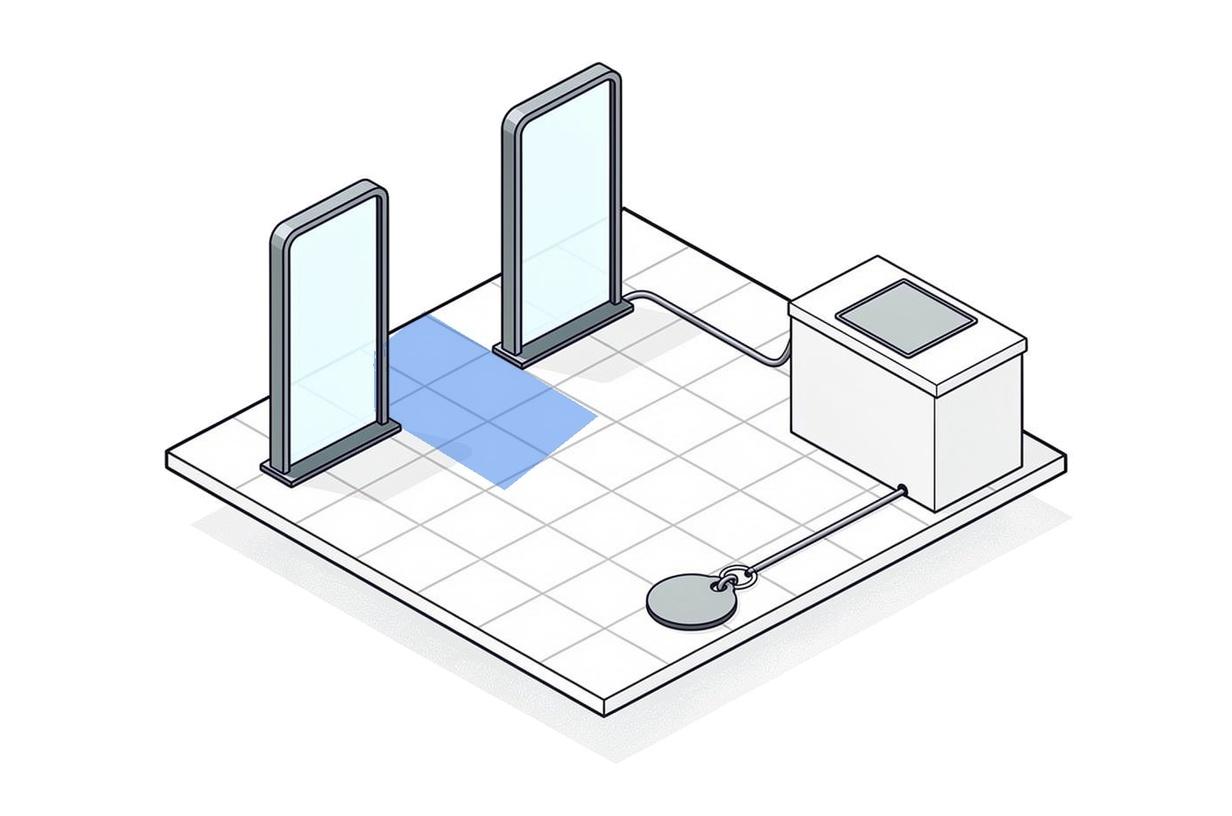
Table of contents
- What sets off alarms in stores
- The components of an electronic article surveillance system
- AM vs RF vs RFID: the three tag technologies
- Why store alarms go off when nothing was stolen
- Integrating EAS with cameras, POS and the alarm panel
- What EAS actually does to shrink
- Retail EAS costs per entrance
- How to scope an anti-theft retail security system so quotes are comparable
- Frequently asked questions
If you have set off a store alarm without stealing anything, or waved a customer through because you assumed the pedestals were wrong again, the cause is simpler than it looks. What sets off alarms in stores is not theft. The pedestals at the door detect a small resonating tag that was supposed to be deactivated or removed at the register and was not. Everything else about electronic article surveillance (EAS) follows from that: which tag technology to use, why false alarms happen, how the door system ties into cameras and the point of sale, and what a properly scoped installation costs per entrance.
What sets off alarms in stores
An EAS system has three parts. A tag or label is attached to merchandise. A pair of pedestals (or an overhead reader, or antennas concealed in the door frame) creates an electromagnetic field across the exit. A deactivator or detacher at the register either kills the label's ability to respond or physically removes the hard tag. The pedestals continuously transmit a signal and listen for a very specific reply. When an active tag passes through the field, it resonates at the system's frequency and the receiver recognizes the response signature, which triggers the audible and visual alarm.
So the alarm is set off by any active tag in the field, whether that tag is on a stolen jacket, on a paid-for item the cashier missed, or on a product bought from another store three days ago. The system has no idea whether a transaction occurred. That distinction drives almost every operational decision that follows.
Common things that trigger a retail store alarm system
- An un-deactivated soft label on purchased goods. A common cause. Labels buried inside packaging, stacked items, or a cashier swiping too far from the deactivation pad all leave a live label.
- A hard tag the cashier forgot to remove. Hard tags cannot be deactivated. If it is still on the garment, the door will alarm every time.
- Tag pollution from other retailers. Source-tagged products (where the manufacturer embeds the label at the factory) that were sold elsewhere and never deactivated will alarm in any store running the same frequency.
- Electrical interference. LED drivers, neon signage, automatic door motors and poor grounding can inject noise at or near the system's operating frequency and cause phantom alarms. Technical troubleshooting guidance on LED driver interference with 8.2 MHz EAS systems describes exactly this failure mode.
- Metal objects and foil-lined bags. Metal near a tag, metal-backed packaging, or a shopping cart passing close to a pedestal can distort the field or detune the tag, producing sporadic alarms or masking real ones. Ask the contractor how the proposed pedestals handle carts and metal fixtures in your doorway.
- Stray tags on the floor or in fixtures near the exit. A live label that fell into a display within range of the pedestals will cause intermittent alarms with no one walking through.
The components of an electronic article surveillance system
When a contractor quotes an EAS system, these are the line items you should expect to see, each priced separately:
- Pedestals or antennas. Sold as a transmitter/receiver pair (one "primary" and one "secondary") or as a single transceiver panel. Wide entrances need multiple pedestals in a row, or an overhead reader.
- Hard tags. Reusable plastic tags attached with a pin and removed at the register with a detacher. The core of most retail clothing security systems. Variants include ink tags (dye vials that rupture if forced off), lanyard tags for footwear and handbags, bottle caps for liquor, and "spider wrap" cable tags for boxed electronics.
- Soft labels. Disposable adhesive labels, often applied at the factory ("source tagging") and deactivated at the register. Used for cosmetics, packaged goods, pharmacy, books and anything a pin would damage.
- Deactivators. Pads, integrated scanner-deactivators, or counter-mounted devices that switch off soft labels. Must match the tag frequency.
- Detachers. Magnetic or mechanical release tools for hard tags. Sensormatic's own product literature specifies its magnetic detachers at 9 kilogauss; ask the contractor whether the detachers quoted match the tags quoted, and whether the tags can be released by generic detachers sold online.
- Retail display security systems are a separate category: cable locks, alarmed display hooks and tethered demo units for phones and tablets. They alarm locally at the fixture rather than at the door and are usually quoted as a separate scope.
AM vs RF vs RFID: the three tag technologies
Every EAS system runs on one of three technologies, and they do not talk to each other. The decision locks in your tags, deactivators and pedestals together. Our retail loss prevention guide puts it simply: switching families means replacing all three.
| Technology | Frequency | Typical pedestal spacing | Best suited to | Trade-offs | Example vendors |
|---|---|---|---|---|---|
| Acousto-magnetic (AM) | 58 kHz | Roughly 4 to 7 ft per pair depending on tag and environment | Mixed merchandise including packaged goods, pharmacy, hardware and grocery | Labels are thicker than RF labels and generally carry a higher unit price | Sensormatic (Johnson Controls) is the brand most associated with AM; sold through many integrators |
| Radio frequency (RF) | 8.2 MHz | About 2.0 to 2.1 m (6.5 to 7 ft) per pair for common pedestals | Apparel, books, soft goods and general merchandise; high-volume source tagging | Thin paper labels are easily detuned by metal or foil near the tag | Checkpoint Systems is the brand most associated with RF; also Ketec, Nedap and a large compatible aftermarket |
| RFID (UHF) | 860 to 960 MHz | Overhead readers typically; Sensormatic specifies two overhead units for a 6 ft opening | Identifies the exact item leaving; doubles as inventory system; can be told which items are sold | Highest cost; requires item-level tagging and software; needs POS integration to know what was paid for | Nedap, Sensormatic, Checkpoint |
The RF spacing figure comes from Sensormatic's RF pedestal product page (up to 2.0 m between pedestals); the AM range and the 2.1 m RF figure come from supplier product listings. Some single-panel vendors claim coverage of 20 ft or more per pair of panels; treat those numbers as configuration-dependent and ask for a demonstration in your actual doorway.
When AM is the right choice
AM is the usual recommendation when a meaningful share of merchandise has metal or foil in or around it: cosmetics, pharmacy, hardware, electronics accessories, grocery and liquor. AM is generally regarded as more tolerant of metal near the tag than RF, but detuning affects both families to some degree, so test the contractor's proposed tag on your actual product samples before committing. The trade-off is that AM labels are thicker and generally cost more per unit than RF labels.
When RF is the right choice
RF suits apparel, books, soft goods and general merchandise where tags sit away from metal. RF labels are paper-thin and, at volume, very cheap, which makes high-volume source tagging practical. Checkpoint retail security systems are the brand most buyers encounter here, but there is a large compatible aftermarket of pedestals, tags and deactivators.
When an RFID retail security system makes sense
RFID answers a question AM and RF cannot: which item left the store. Each tag carries a unique serial number tied to a SKU. When the exit reader sees a tag that the POS has not marked as sold, it alarms, and the loss prevention team knows exactly what walked out and when. Because the same tags drive inventory counts and omnichannel fulfillment, retailers who already tag at item level for inventory are the natural RFID-EAS adopters. Nedap, for example, publishes detection performance "up to 95%" for its iD Gate Pro exit reader; that is a manufacturer figure, not an independent one, and should be pilot-tested. Sensormatic's catalogue notes that its Overhead 360° RFID exit reader requires two units for a 6 ft opening and a hardware license, which is the kind of detail that changes an installed quote materially.
Hybrid tags exist for the transition. Sensormatic sells a magnetic AM/RFID hard tag that gives you AM door protection today and item-level RFID data when you are ready for it.
Why store alarms go off when nothing was stolen
Store staff tune out an alarm that cries wolf, and a system nobody responds to is worth nothing. Before signing a contract, ask the contractor to walk through each cause below and tell you how the proposed system handles it.
- Deactivation misses. Vendor guidance lists deactivation height and technique as common causes of missed deactivations: the label has to pass close enough to the pad, in the right orientation. Ask whether deactivation in the proposed system is tied to the barcode scan or is a separate manual step, and how the contractor trains cashiers on it.
- Tag pollution. If a retailer across the parking lot runs the same frequency and does not deactivate properly, their customers will set off your doors. With AM and RF the fix is staff protocol: check the receipt, locate the live tag, deactivate it, move on. RFID exit readers can be configured to filter out tags that are not yours.
- Environmental noise. New LED lighting, a new automatic door operator, or a neighbor's equipment can start a false alarm problem months after a clean installation. Ask the contractor to run a noise survey at commissioning, document it, and state what filtering the pedestals offer against later interference.
- Tags near the pedestals. Live product displayed within the detection field, or labels that fell into a floor mat, will cause intermittent alarms. Keep tagged merchandise outside the field distance the contractor specifies.
- Metal fixtures and carts. Shopping carts and metal fixtures near the pedestals can distort the field. If carts exit through your pedestals, say so during scoping so the contractor can specify and test accordingly.
In our experience scoping retail projects, one of the most useful questions to put to a contractor is a simple one: What is your expected false-alarm rate in this specific doorway, and what will you do if it is exceeded? Vendors who have commissioned hundreds of entrances will answer with specifics about your door width, flooring and nearby equipment. Vendors who have not will change the subject.
Integrating EAS with cameras, POS and the alarm panel
A pedestal alarm on its own tells you only that a live tag passed through at a given second. Three integrations turn that into evidence and into a staff response.
Camera integration
The pedestal's alarm relay is wired to a camera input or to the video management system. Each alarm event bookmarks the footage from the entrance camera (and ideally a second camera facing inward) so loss prevention can pull up every alarm clip in a day in seconds rather than scrubbing hours of video. Ask whether people counting through the pedestals is included, since it gives you a conversion metric from the same hardware. Camera specifications, retention and installed costs are covered in our security camera installation cost guide.
POS integration
For AM and RF, POS integration mostly means scanner-integrated deactivation: the label is killed when the barcode is read, so a line item in the transaction equals a deactivated tag. For RFID, POS integration is essential: the system must learn which serial numbers were sold so it alarms only on unsold items. In both cases, pairing with transaction-linked video and exception reporting lets you see whether an alarm corresponds to a real sale, a void, or no transaction at all. Get the supported POS platforms and versions in writing.
Intrusion alarm integration
EAS pedestals operate during business hours. Your commercial intrusion alarm system covers the hours they are off. These are separate systems and separate contracts, but door contacts, glass-break sensors and the EAS relay can share one panel and one monitoring account, which is worth asking about when you scope the whole storefront.
What EAS actually does to shrink
The most recent full NRF National Retail Security Survey put average shrink at 1.6% of sales in FY2022, or $112.1 billion, up from 1.4% the prior year, with theft, internal and external combined, accounting for roughly two-thirds of it. For a $3 million-a-year store, 1.6% is $48,000, so even a partial reduction in the theft share is worth pricing against the system cost.
Does EAS deliver that reduction? The independent evidence is positive but uneven. A peer-reviewed systematic review of retail tagging studies in Crime Science identified eight studies with quantitative results, five of them positive: a 52.6% shrink reduction in one retailer's trial of soft labels on meat, a 28.3% reduction in a 1994 hard-tag study, and others showing no measurable effect or even increases after a retailer switched tag types. The reviewers concluded that tag effectiveness depends on store staff, customers, tag type, product type and follow-through, and found suggestive evidence that more visible tags produce larger reductions than less visible ones. Our reading for buyers: the hardware is the smaller half of the outcome, and staff response to alarms is the larger half.
Retail EAS costs per entrance
EAS is quoted per exit and per thousand tags, plus the register-side hardware. We found no comprehensive manufacturer price list, so the figures below come from US reseller listings, one published installer quote and one market estimate. Use them to sanity-check a quote, not to replace one.
| Line item | Typical range (USD) | Notes |
|---|---|---|
| RF pedestal pair, new | $1,500 to $4,000 | Reseller listings show single-entrance RF systems from roughly $1,499 to $3,999 for dual-pedestal systems; dual-aisle packages approach $6,000 |
| AM pedestal pair, new | $2,250 to $4,100 | Listings show an AM pillar package at $2,250 and AM primary/secondary posts at $2,800 and $1,300 respectively |
| Installation and commissioning | $900 to $1,500+ per installation visit | One installer's published quote for a Sensormatic AM post: $900 to $1,500 "or more" depending on location and tower count. A market report estimates $150 to $300 per pedestal for basic deployment. Floor coring, conduit and power runs are extra |
| Deactivator pad | About $300 per register | Basic RF pads list around $299; scanner-integrated deactivation is quoted separately |
| Detacher | Quoted per register | Not in published list pricing; confirm it matches the tag family and magnetic strength quoted |
| Soft labels (RF) | $0.006 to $0.04 each | Reseller example: 2,000 RF labels for $80, or $0.04 each; high-volume OEM listings fall below a cent. AM labels are generally priced higher per unit |
| Hard tags | Quoted per thousand | Reusable; reseller packs of Sensormatic-compatible hard tags list around $280 to $295; ask for per-thousand pricing by tag type |
| RFID tags | $0.12 to $0.33 each | An integrator example cites $0.12 to $0.18 for dual-purpose tags; distributor pack pricing implies $0.23 to $0.33; plus reader hardware licenses and software |
Adding those lines for a single standard entrance with one pedestal pair and two equipped registers, before tags, gives roughly $3,000 to $6,000 for RF and $3,800 to $6,200 for AM using the listings above; that is arithmetic on published listings, not an installed quote, and your contractor's number will move with door width, floor construction and brand. Wide entrances with three or more pedestals, concealed in-floor antennas or overhead RFID readers cost considerably more per exit, and RFID-EAS deployments carry software and integration costs: one integrator example puts middleware licensing and setup at $15,000 to $40,000 for a single site. Resellers also list refurbished pedestals from the major brands; if you go that route, insist that the installing contractor warranties them.
Lease, service contract or outright purchase?
Some vendors offer EAS as a bundled monthly service covering pedestals, maintenance and tag supply rather than an outright sale. That spreads the cost, but you may not own the pedestals at the end of the term, and the tag pricing inside the bundle is often not itemized. Others sell outright with an optional annual service agreement. Neither model is wrong, but they are not comparable until you lay them side by side over the full term, which is the same discipline we apply to alarm monitoring contracts. Ask, in every quote: Who owns the pedestals at the end of the term? What is the per-thousand price for replacement labels, and is it fixed? What is the response time for a pedestal fault, and is a loaner provided?
How to scope an anti-theft retail security system so quotes are comparable
Quotes for the same store can differ by thousands of dollars simply because contractors assumed different things. When we build a scope for a retail project, we pin down the following before any contractor prices it, and we recommend you do the same whether or not you use our service:
- Entrance count and clear width of each opening, including emergency exits that need coverage and whether carts pass through.
- Product mix: what percentage of merchandise is apparel, packaged goods with foil, liquids, electronics. This decides AM vs RF.
- Existing tag commitments: if your suppliers source-tag at a particular frequency, you want that frequency at the door or you pay to re-tag everything.
- Register count and POS platform, so deactivation and any integration are priced per lane.
- Tag inventory: starting quantity of hard tags and soft labels, and the expected annual consumption.
- Camera and alarm integration required, and who provides the relay wiring.
- Floor construction: slab coring for in-floor conduit is a real cost line and should be in the quote, not a change order.
- Ownership and service terms, so a lease is not compared against a purchase as if they were the same number.
Every contractor we match to a retail project is checked for active state low-voltage or alarm licensing, a current certificate of insurance and prior work on comparable retail buildings. We do not install or sell equipment ourselves, and contractors pay us for introductions, so the quotes come to you free and are built against the same scope so you can read them line by line. If that is useful, you can request retail security quotes here, or read our full retail loss prevention guide first.
Frequently asked questions
What sets off store alarms if I did not steal anything?
Usually a live EAS tag that was not deactivated or removed at the register, either on something you just bought or on a product from another store running the same frequency. Occasionally electrical interference or a stray tag near the pedestals triggers an alarm with nobody carrying a tag at all. Show your receipt and let staff locate and deactivate the label.
Can AM tags be used with RF pedestals, or vice versa?
No. AM operates at 58 kHz and RF at 8.2 MHz; the pedestals cannot detect the other type, and the deactivators do not work across families. If your suppliers source-tag in one frequency, that is a strong argument for matching it at the door.
What is source tagging?
Source tagging means the manufacturer or distributor applies the EAS label or sews in the tag before the product reaches the store, so staff do not tag in the back room. It improves tagging consistency and cuts labor, but it ties you to the frequency your suppliers use, and it is the main reason customers carry live tags from one store into another.
What should I ask about service life and support?
Rather than relying on a quoted lifespan, ask for the warranty term on pedestals and deactivators, the guaranteed response time for a fault, whether a loaner pedestal is provided, and how long replacement boards and power supplies will remain available for the model quoted. Budget the recurring cost as labels, replacement hard tags and an annual service visit.
Is an RFID retail security system worth it for a single store?
Rarely on loss prevention alone. The business case for RFID is inventory accuracy and omnichannel fulfillment, with exit detection as a byproduct. A single-location store with no item-level tagging program will usually get better value from AM or RF pedestals integrated with cameras and scanner-based deactivation.
Are refurbished EAS pedestals a reasonable buy?
They can be, if a licensed contractor installs them, tunes them in your doorway and warranties the system. The scenario to avoid is a pedestal pair bought online and self-installed without a noise survey or tuning, because interference and placement problems then have nobody responsible for fixing them.
Ready to get started?
Talk to our team and see how we can help.