Fire Alarm Control Panels Explained: Conventional vs Addressable, Types and Replacement Costs
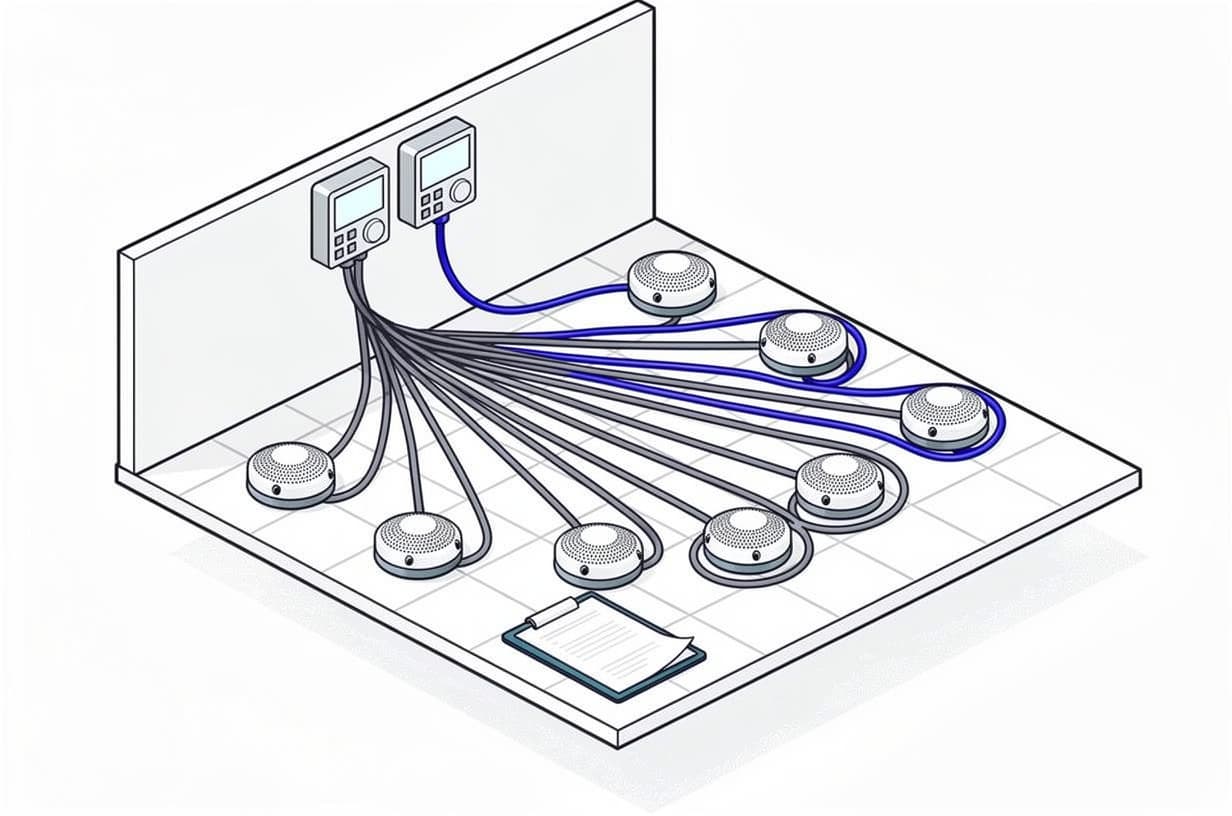
Table of contents
- What is a fire alarm control panel?
- Conventional vs addressable vs wireless
- The five types of commercial fire alarm systems
- Proprietary vs open fire alarm panels
- When to replace or upgrade an aging panel
- Fire alarm control panel installation cost
- What a correct panel installation includes
- Panel maintenance after installation
- Questions that make panel quotes comparable
- What is the best commercial fire alarm system?
- Frequently asked questions
The fire alarm control panel is the one component of a commercial fire alarm system that every other part depends on. Detectors, pull stations, horn/strobes, the sprinkler flow switch, the elevator recall relay and the communicator that calls the monitoring station all terminate at the panel, and the panel decides what happens when any of them changes state. It is also the component buyers understand least, which is why panel quotes vary so much. One contractor proposes a $2,000 conventional panel, another a $7,000 addressable one, a third insists the existing panel only needs a new board, and all three can be technically correct.
What is a fire alarm control panel?
A fire alarm control panel (FACP, or "fire alarm control unit" in NFPA language) is the listed control equipment that powers, supervises and interprets a building's fire detection devices, then operates the outputs the system is designed to trigger. In practice it does five jobs:
- Supervises the circuits. It continuously monitors the wiring to every initiating device and notification appliance and reports a trouble condition if a wire breaks, shorts, or a device is removed.
- Classifies signals. It distinguishes alarm (smoke, heat, pull station, waterflow), supervisory (closed sprinkler valve, low air pressure, duct detector) and trouble (ground fault, low battery, communicator failure), because each requires a different response.
- Drives the outputs. It powers the horn/strobes or voice speakers, recalls elevators, releases magnetically held doors, shuts down air handlers and triggers suppression where those interfaces exist.
- Transmits off-site. Through a built-in or attached communicator it sends alarm, supervisory and trouble signals to a supervising station.
- Keeps the record. Modern panels log events, hold the device map and programming, and are the first thing an inspector or responding fire crew reads.
Panels sold in the United States are listed to UL 864 (control units and accessories for fire alarm systems), and their installation, wiring classes, power supply and testing are governed by NFPA 72 as adopted by your local authority having jurisdiction (AHJ). Our commercial fire alarm service page lists everything a complete scope wraps around the panel: detectors, pull stations, notification appliances, communicator, interfaces, batteries, as-builts and the record of completion. Which edition your AHJ enforces matters: it determines the battery calculations, circuit classes and inspection intervals the panel has to satisfy.
Conventional vs addressable vs wireless
The split that matters most to cost and operability is how the panel knows where a signal came from.
Conventional panels
A conventional fire alarm control panel wires devices in zones. Each initiating device circuit (IDC) is a loop of detectors and pull stations, and when any device on that loop goes into alarm, the panel reports the zone, not the device. A 4-zone panel in a 3,000 sq ft restaurant might have "Kitchen," "Dining," "Storage" and "Sprinkler waterflow." Staff and firefighters then search the zone to find the source. Conventional panels are inexpensive, simple to program, and perfectly adequate when the zone is small enough to search quickly. Their limits show up as buildings grow: more zones mean more home-run wiring, every device added later needs a path back to a zone circuit, and a trouble on a loop tells you only that something on that loop is wrong.
Addressable panels
An addressable panel communicates digitally with each device over a signaling line circuit (SLC). Every detector, pull station and monitor module has a unique address, so the panel displays "Smoke detector 2-17, 2nd floor east corridor" instead of "Zone 2." Analog addressable (often marketed as "intelligent") detectors also report their sensitivity reading, which lets the panel flag a drifting detector before it causes a nuisance alarm and gives the inspector a sensitivity record from the panel. Addressable panels cost more per point and require manufacturer-specific programming, but they cut wiring on larger buildings because dozens of devices share one SLC loop, and they make troubleshooting and future expansion simpler.
Wireless commercial fire alarm systems
A wireless commercial fire alarm system still has a panel; what changes is that some or all devices talk to it over a listed low-power radio mesh instead of copper. NFPA 72 covers these under its low-power radio provisions, which require listed equipment, supervision of every device, low-battery reporting and automatic retransmission of alarm signals until restored, so a wireless system is held to the same signal integrity as a wired one. The practical use case is retrofit: historic buildings, finished tenant spaces, buildings where conduit runs would mean opening plaster or running overhead through occupied floors. Honeywell's SWIFT documentation states UL 864 and UL 268 compliance for its wireless gateway and devices, and Hochiki publishes wireless detector and sounder lines; in both cases the wireless devices attach to the manufacturer's addressable panel, so a "wireless" system is in practice an addressable system with radio loops. Confirm the UL listing of the specific products proposed, budget device battery replacement as a recurring maintenance line, and bring the AHJ in early, since range, interference and supervision draw more review scrutiny than a wired design.
| Attribute | Conventional | Addressable | Wireless (addressable radio) |
|---|---|---|---|
| What the panel reports | Zone in alarm | Exact device and location | Exact device and location |
| Wiring | One circuit per zone, home-run to panel | Shared SLC loop, many devices per loop | Radio mesh plus a wired gateway |
| Best fit | Small, simple buildings; sprinkler supervision panels | Multi-story, multi-tenant, anything over roughly 20,000 sq ft | Retrofits where cabling is impractical |
| Panel price (equipment) | $1,500 – $3,000 | $3,500 – $8,000 | Addressable panel plus gateway and wireless devices |
| Expansion | Limited by zone count, new wiring each time | Add a device to the loop and program it | Add a device within radio range |
| Service | Any licensed fire alarm contractor | Depends on brand: open or dealer-only | Depends on brand |
The panel prices above are the equipment ranges from our commercial fire alarm cost guide; as our repair guide notes, they are for the panel, with labor, programming and testing on top. We cover the installed picture below.
The five types of commercial fire alarm systems
The industry does not use a single fixed list, but proposals and spec sheets commonly distinguish these five categories:
- Conventional systems. Zone-based panels as described above. Still the right answer for small occupancies and for a dedicated sprinkler supervisory panel in a warehouse that needs waterflow and tamper monitoring but not building-wide notification.
- Addressable systems. Device-level reporting over an SLC. We recommend it for buildings over roughly 20,000 sq ft, multi-story buildings and anything with a substantial device count.
- Analog addressable (intelligent) systems. Addressable systems whose detectors report measured values, enabling drift compensation, pre-alarm thresholds and automatic sensitivity testing. Many current addressable panels fall in this category.
- Wireless and hybrid systems. Addressable panels with some or all devices on a listed radio mesh. Hybrid systems mix wired loops in the core with wireless loops in hard-to-reach areas.
- Voice evacuation and emergency communication systems. Panels with integrated or networked audio that deliver recorded and live voice messages instead of, or in addition to, horns. Voice systems carry stricter battery and testing obligations than horn/strobe systems; the building code for your occupancy determines whether you need one.
"Automatic fire alarm system" is a related term you will see in code and in proposals: it means a system in which detectors initiate the alarm without human action, as opposed to a manual system that relies solely on pull stations. Commercial systems are automatic by design, with pull stations added as the manual backup.
Proprietary vs open fire alarm panels
This distinction shapes what you pay for service for the life of the panel, and it rarely appears in a proposal.
A proprietary (dealer-only) panel is sold, programmed and serviced only through the manufacturer's authorized distributors. Honeywell's Notifier line, for example, is sold through Authorized Engineered Systems Distributors; Kidde's engineered systems go through a closed dealer program. For any other brand, ask the bidder in writing whether parts and programming software are openly sold. Dealer-only platforms are often excellent, and for a large campus or high-rise with networked panels and voice evacuation they may be the only sensible choice. The trade-off is that when the installing dealer's service pricing rises, you may have few or no competing firms able to program it.
An open-distribution panel is one whose equipment and programming software are sold through general electrical and life-safety distribution rather than a restricted dealer network; Honeywell positions its Fire-Lite and Silent Knight brands this way, and you should confirm the status of any proposed panel with the manufacturer or distributor. Any licensed fire alarm contractor can buy parts and, with the installer passcode, program and service it. Our fire alarm repair guide goes into the failure modes we see when owners do not know which kind they have: withheld installer codes, exclusive-service clauses, provider-owned communicators, and a replacement-board quote with no competing bid possible.
Neither choice is wrong. What is wrong is discovering which one you bought five years in. Ask the question at bid time, get the installer code and the programming file named as deliverables in the contract, and if you accept a dealer-only platform, negotiate inspection and service pricing before the panel is installed, when you still have leverage.
When to replace or upgrade an aging panel
Panels more often become unsupportable, non-compliant or uneconomic than fail outright. Common triggers:
- Parts are discontinued. When the manufacturer stops making the main board or loop cards, a single component failure turns into a panel replacement on an emergency timeline, with fire watch costs while the building is impaired. If your panel model has been out of production for several years, price the replacement now, on your schedule.
- The building changed. Tenant build-outs, additions and change of occupancy add devices and interfaces a zone-limited conventional panel cannot absorb. Panels at or near capacity on zones or SLC points are replacement candidates.
- Communicator path is obsolete or not yours. A panel whose communicator depends on a retired cellular network or a copper phone line needs a new communicator at minimum, and a leased communicator may be removed when the monitoring contract ends. Confirm paths and ownership before deciding whether the panel behind it is worth keeping.
- Repeated nuisance alarms and troubles. Intermittent ground faults, false alarms from aging conventional detectors with no sensitivity reporting, and recurring battery troubles are a pattern, not a series of unrelated service calls.
- The AHJ or insurer requires it. A failed annual inspection, a change in adopted code edition, or an insurance carrier's survey can make replacement a condition of occupancy or coverage.
- Service costs are climbing. When repair spend keeps rising and only one dealer can bid on it, price a replacement alongside the next repair and compare the two on a five-year basis.
Note that panel replacement and system replacement are different projects. In many buildings the field devices and wiring are serviceable and only the panel, communicator and batteries change; in others, aging detectors that no longer pass sensitivity testing push the project into a full device swap. A good contractor will walk the building and tell you which project you have before pricing it.
Fire alarm control panel installation cost
Fire alarm panel installation cost splits into equipment, labor, programming and commissioning, and third-party fees. The equipment figures below are the planning ranges from our cost guide; the rest are the line items we see on comparable quotes.
| Cost component | Typical range | Notes |
|---|---|---|
| Conventional panel (equipment) | $1,500 – $3,000 | Zone-level reporting; small buildings and sprinkler supervision |
| Addressable panel (equipment) | $3,500 – $8,000 | Device-level reporting; capacity and voice options push the top end higher |
| Communicator (cellular / dual-path) | Equipment varies; cellular or dual-path service adds $5 – $20 per month | Confirm whether you or the monitoring company owns it |
| Labor, programming, testing | 40 – 60 percent of the project total | Panel swap on existing wiring is far less labor than a full system retrofit |
| Engineered drawings and permit fees | $300 – $1,500 | A separate stamped design starts around $1,000 even on small buildings |
| Annual inspection and testing | $250 – $1,200 per year | Get this priced at bid time, not after installation |
| Fire monitoring | $30 – $110 per month | Fire-only, single panel, UL-listed station |
As whole projects, a small conventional system under 5,000 sq ft runs $2,000 – $12,000, a mid-size addressable system of 5,000 to 25,000 sq ft runs $12,000 – $60,000, and large or occupied retrofits above 25,000 sq ft run $60,000 – $250,000 and up. New construction prices at roughly $1 to $3 per square foot; occupied retrofits run $4 to $12 because of phased cutovers in occupied space. Addressable systems typically price 30 to 60 percent above comparable conventional systems per our cost guide. Supply-side pricing has also moved: a 2026 Oklahoma materials-cost report notes addressable panels saw the sharpest increases and lead times of 10 to 16 weeks for custom configurations, which is one more reason to replace on a plan rather than after a failure.
A panel-only replacement on sound existing wiring usually lands at the panel price plus labor, programming of every existing device into the new panel, a new battery set, a new communicator, and a witnessed acceptance test. If the quote does not say "100 percent of devices tested" and "record of completion delivered," it is not a complete panel replacement quote.
What a correct panel installation includes
Beyond the price, a few details separate an installation that passes inspection from one that gets red-tagged.
Location and fire alarm panel installation height
NFPA 72 does not dictate where the panel goes; NFPA's own guidance is that the location is left to the AHJ, and most jurisdictions want it near the main entrance or paired with a remote annunciator there so responding crews can read it on arrival. High-rise codes typically require it in the fire command center. Since the 2019 edition, NFPA 72 does set mounting limits for control equipment: operable controls no higher than 6 ft (1.8 m) and no lower than 15 in (375 mm) above the finished floor. If the panel sits in a room that is not continuously occupied, a smoke detector (or heat detector where smoke detection is unsuitable) must protect the panel itself. Manual pull stations are a separate question governed by accessibility rules, which is why you see them mounted at 42 to 48 inches.
Standby power
Every panel needs secondary power sized for the system it serves. Under NFPA 72 the baseline is 24 hours of standby followed by 5 minutes of alarm; voice evacuation and emergency communication systems need 24 hours plus 15 minutes of full operation. The battery calculation, along with voltage-drop calculations for the notification circuits, is part of the plan-review submittal, and the battery set it produces has to fit the panel enclosure or a listed auxiliary cabinet.
Interfaces and the communicator
Elevator recall, door holder release, HVAC shutdown, access-control egress release and sprinkler supervision each need a relay or monitor module, a written responsibility for who wires it, and a line in the acceptance test. Our industry guides for healthcare facilities, schools and office buildings cover the fire alarm and locked-egress interlocks that most often get missed. The communicator is the other item to pin down: who owns it, which paths it uses, and whether the monitoring account can move to another station without replacing it. Our guide to commercial fire alarm monitoring walks through what the code requires of the supervising station and what to look for in the contract.
Permits, acceptance test and paperwork
A fire alarm panel installation is a permitted life-safety project almost everywhere. Expect plan review with stamped drawings (NICET-certified or PE-designed, depending on the state), a witnessed acceptance test with the AHJ, and a Record of Completion plus as-built drawings handed to you, not retained by the contractor. Our guide to permits, inspections and AHJ sign-off lists what inspectors check.
Panel maintenance after installation
NFPA 72 Chapter 14 sets the inspection, testing and maintenance schedule, and the intervals depend on the edition your AHJ has adopted and on whether the panel is monitored by a supervising station: unmonitored control equipment is checked far more often than monitored equipment, visual inspections and functional tests run on different clocks, and some device types carry shorter intervals than others. Editions differ, and our own pages summarize the intervals differently (compare the schedule on our fire alarm service page with the FAQ in our cost guide), so treat any summary, including ours, as a cross-check and Chapter 14 of the adopted edition as the authority. Your contractor's inspection proposal should cite that edition and table.
For the panel itself, three items account for most service calls: sealed lead-acid standby batteries, which have a practical life of three to five years and should be load-tested annually and replaced on a schedule rather than after a low-battery trouble; the communicator, whose paths and test-signal timing must be verified; and the programming, which should be backed up off-site after every change. Keep the inspection reports; they are what the AHJ, your insurer and the next contractor will ask for.
Questions that make panel quotes comparable
The reason panel quotes are hard to compare is that contractors scope them differently. These questions force the scope into the open:
- Is this a panel replacement, a system extension, or a full system replacement? Each reuses a different amount of existing wiring and devices, and the AHJ may treat them differently at plan review.
- Which panel make and model, and is it open distribution or dealer-only? Ask who else in the metro can service it.
- What is the point or zone capacity, and how much is spare? A panel at 90 percent capacity on day one is a change order waiting to happen.
- Will the installer passcode, programming file, as-builts and Record of Completion be handed over, and is that in writing?
- Who owns the communicator, which paths does it use, and what happens to it if monitoring moves?
- Which NFPA 72 edition and local amendments is the design based on, and who stamps the drawings?
- Does the price include permit, plan review, witnessed acceptance test of 100 percent of devices, and fire watch during cutover?
- What are the annual inspection price and the monitoring rate, term and renewal terms? A low installed price can be recovered through a 60-month monitoring agreement with an automatic renewal; our monitoring contract scorecard covers the renewal, escalator and termination terms to check.
- Which of your technicians is NICET-certified, and what is the state fire alarm license number?
This is the standardization we build into every fire alarm request that comes through us. Before a contractor quotes through our network we verify the state alarm or low-voltage license, keep an insurance certificate on file, and check complaint history, and we send each contractor the same building profile so the quotes come back with the same scope, the same deliverables and the same monitoring and inspection terms laid out side by side. We do not install, monitor or sell equipment, and contractors pay for the introductions, so the service is free to the building owner.
What is the best commercial fire alarm system?
There is no best panel, only the best fit for a building's size, occupancy, code requirements and service market. A reasonable default:
- Single-tenant building under roughly 5,000 sq ft, simple layout: a conventional panel from an open-distribution brand, monitored, with capacity for two or three spare zones.
- Multi-story, multi-tenant, or above roughly 20,000 sq ft: an addressable panel. Choose open distribution unless you have a specific reason (networked campus, voice evacuation integration, an existing dealer relationship you have priced) to go proprietary.
- Any occupancy where the building code may call for voice evacuation or emergency communication: confirm that requirement first; it decides the panel family before anything else does.
- Historic or finished-space retrofit: an addressable panel with listed wireless loops where cabling is impractical, approved by the AHJ before you sign.
Whatever the category, the system that will serve you best is the one whose programming you own, whose parts any licensed contractor can buy, and whose inspection and monitoring pricing you negotiated while you still had three bids on the table.
Frequently asked questions
What is the difference between the panel and the fire alarm system?
The panel is the control unit; the system is the panel plus every initiating device, notification appliance, interface and communicator connected to it. You can replace a panel without replacing the system, and many retrofit projects do exactly that when the field wiring and devices are serviceable.
How long does a commercial fire alarm panel last?
A panel's practical life ends when the manufacturer stops supporting its boards and software, not when the hardware wears out. Plan on standby batteries every three to five years and on replacing detectors that fail sensitivity testing.
Can I replace a conventional panel with an addressable one using the existing wiring?
Sometimes, but only after the contractor has verified the wire type, insulation condition and circuit class of the existing loops and confirmed the new panel's SLC requirements against them. Treat any proposal that promises wiring reuse without a site test as incomplete.
Does an addressable panel make inspection and troubleshooting easier?
Device-level reporting tells the technician, and the responding fire crew, exactly which device is in alarm or trouble rather than which zone, and the panel's event log and sensitivity readings give the inspector a record to work from. Whether that lowers your annual inspection price depends on the contractor, so ask for the inspection quote alongside the installation quote.
Who is allowed to install a commercial fire alarm panel?
A contractor holding the fire alarm license class required by your state (some states license fire alarm work separately from general low-voltage work), with design by a NICET-certified technician or professional engineer where the AHJ requires stamped drawings. Dealer-only panels additionally require the manufacturer's authorized distributor. Our guide to commercial fire alarm installation explains how to check those credentials.
How do I get comparable fire alarm panel quotes?
Give every contractor the same building profile, require the same deliverables, and insist on separate line items for equipment, labor, permit, inspection and monitoring. If you would rather not run that process yourself, request fire alarm quotes through us: one form, licensed and insured contractors matched to your building type, and pricing you can compare line for line at no cost.
Ready to get started?
Talk to our team and see how we can help.