Business Security Systems with Cameras: Installed Alarm-Plus-Video Costs, Monthly Monitoring and Who Should Quote It (2026)
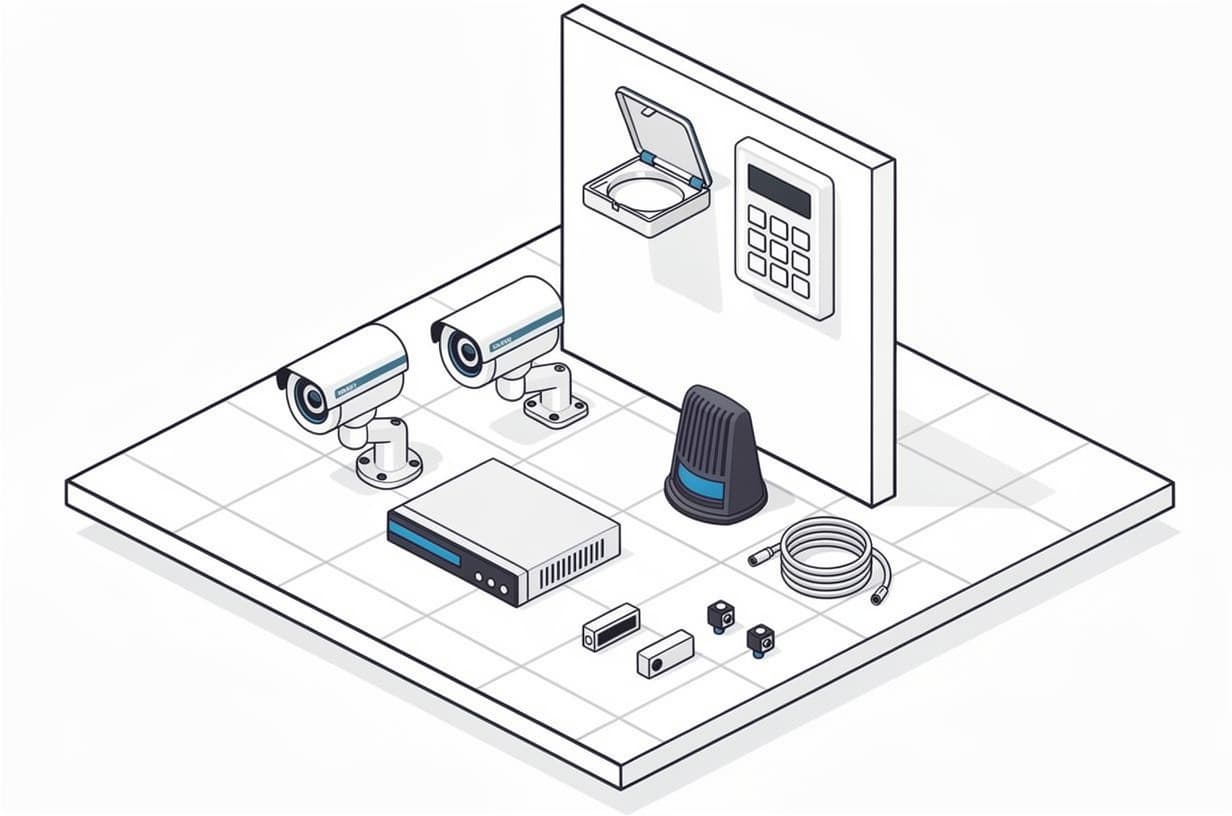
Table of contents
- How we compared these options
- Security systems with cameras for business: three ways to buy, compared
- Which providers can quote alarm, cameras, access and fire together?
- What a bundled alarm-plus-camera package actually includes
- How many openings and cameras does your building need?
- Cost of a security system for business by building size
- Business alarm systems pricing: the contract terms that decide the real cost
- Best small business security system: home-grade or commercial-grade?
- How to get business security camera installation bids you can compare line for line
- Frequently asked questions
Most businesses shopping for business security systems with cameras are really buying two things on one invoice: a monitored intrusion alarm and a recorded video system. In September 2026, that combined package runs roughly $3,000 to $25,000 installed for a single-building business, with $40 to $150 a month for monitoring on top (basic intrusion monitoring alone can start around $30). A 2,000 sq ft storefront sits at the bottom of that range; a 6,000 sq ft office with 12 openings and 8 cameras lands near $15,000 installed and about $90 a month; a 20,000 sq ft warehouse can push past the top. The full breakdown is in our commercial security system cost guide.
Which provider should quote it? For alarm, cameras, access control and fire on one contract, the national integrators (Everon, Securitas Technology, Johnson Controls) will do all four for mid-size and large facilities, ADT Business covers alarm, video and access for small commercial spaces, and a licensed local integrator with NICET-certified fire staff can quote all four for a single building and can be asked to itemize installed and monthly pricing, which none of the national brands publishes. The self-install brands (SimpliSafe, Ring, Vivint) cover alarm and cameras only. The rest of this page compares those routes on the four numbers that decide the deal: installed cost, true monthly total, contract term, and who owns the equipment when it ends. If you would rather skip to comparable bids, you can request quotes from vetted local contractors in about five minutes.
How we compared these options
A note on where we sit. We do not install, monitor, service or mark up security equipment. We match businesses with licensed, insured local contractors, and those contractors pay us for the introduction, so the service is free to you. That means we have no camera line to push and no monitoring book to protect, which is why this comparison can talk about installed cost and equipment ownership instead of star ratings.
We did not lab-test hardware, and we do not score providers out of 10. We compared each route on what a business owner actually signs: installed cost for a defined scope, the monthly total once monitoring and cloud storage are included, contract length and renewal mechanics, equipment ownership on exit, and service response. Provider facts come from the companies' own business pages and terms, cited inline; where a company publishes no business pricing, we say so rather than guess. Cost figures come from our published cost guides, linked where each figure appears.
Security systems with cameras for business: three ways to buy, compared
There are three routes to an installed alarm-plus-camera package.
| Factor | National pro-install brand | Self-install small-business brand | Licensed local integrator (quoted through us) |
|---|---|---|---|
| Examples | ADT Business, Everon, Securitas Technology, Johnson Controls | SimpliSafe, Ring, Vivint | Regional low-voltage contractors holding a state alarm or low-voltage license |
| Typical installed cost | Low upfront on subsidized offers (ADT advertises a $349 minimum install); full commercial scopes quoted only after a site visit | $500 to $3,000 in hardware; optional pro install extra | $3,000 to $25,000 for a full alarm-plus-camera scope, itemized (request itemized quotes) |
| Monthly monitoring | ADT Business from $54.99/mo; enterprise rates negotiated | $20 to $100/mo (Ring Pro $19.99; Virtual Security Guard $99.99) | $30 to $75/mo basic intrusion; $60 to $150 with fire |
| Cloud or storage fee | Bundled into plan tiers; on-site recorder optional | Included in plan up to a device cap; 24/7 recording extra per camera | On-site NVR ($300 to $3,000) or $10 to $30 per camera/mo cloud |
| Video verification | Yes, on higher tiers | Yes, on select plans (agent views live clip) | Yes, via UL-listed central station; priced per account |
| Typical contract | 36 months minimum is common | Month to month, no long-term contract | 36 to 60 months is common; shorter terms are negotiable when you buy the equipment outright |
| Auto-renewal | Common; successive terms unless cancelled in a notice window | None | Common; window usually 30 to 60 days, negotiable in writing |
| Who owns the equipment at the end | Often the provider on subsidized deals; confirm before signing | You | You, when purchased outright; confirm panel is non-proprietary |
| Service response | National dispatch; response times vary by market | Phone and chat support; hardware swaps by mail | Local technician; agree a response SLA in the contract |
| Best fit | Multi-site or enterprise; small business wanting one national brand | Very small premises with a low compliance burden | Single buildings of almost any size, regulated industries, anyone who wants itemized pricing |
Two things the table cannot show. First, a national brand and a local integrator may install comparable panels and cameras; the difference is usually in pricing model and contract structure, not the hardware on the wall. Second, "self-install" prices look small because they exclude the labor, cabling and permits that a commercial building requires anyway.
Which providers can quote alarm, cameras, access and fire together?
In one sentence each: ADT Business suits a small commercial space that wants intrusion, video and access from one national brand on a 36-month term. Everon suits enterprise and multi-site portfolios that need security, fire and monitoring under one national account. Securitas Technology suits mid-size and multi-site businesses that want integrated systems with remote video monitoring. Johnson Controls suits campuses and industrial facilities where security ties into fire and building automation. A licensed local integrator suits a single building of almost any size and will itemize pricing; requesting those local bids through an independent marketplace adds licence and insurance screening and side-by-side terms. Fuller entries follow, in no ranked order.
ADT Business
Suits a small commercial space (retail, café, clinic, professional office) that wants intrusion, video and access control from one national brand with professional installation. The trade-off is the contract: ADT's current business offer requires a 36-month monitoring agreement starting at $54.99 a month with a $349 minimum install, and early-cancellation fees apply. Confirm equipment ownership in writing, because low install pricing can mean subsidized, provider-owned hardware.
Everon
Formerly ADT Commercial, Everon describes itself as serving enterprise-scale commercial customers and covers intrusion, access, video, fire and life safety, and UL-listed monitoring under one national account program. It suits multi-site portfolios, cannabis operators, healthcare and government buyers. The trade-off is that nothing is priced until a sales engineer scopes the site, and a single small office is not the buyer it is built for.
Securitas Technology
Securitas Technology (the former Stanley Security) offers intrusion, video, access, electronic article surveillance and remote video monitoring, with vertical practices in retail, commercial offices, education and healthcare. It suits mid-size and multi-site businesses that want integrated systems from a provider that also runs a guarding business. The trade-off is that its standard terms can keep equipment ownership with Securitas unless agreed otherwise, and renewal is typically automatic, so read the term sheet.
Johnson Controls
Johnson Controls both manufactures the brands many installers use (DSC intrusion panels, Kantech access, Exacq video, Software House) and acts as an integrator for large facilities where security ties into fire and building automation. It suits campuses, industrial sites and institutions. The trade-off is scale: it is not built to compete on a single storefront, and pricing is entirely quote-based.
SimpliSafe Business
SimpliSafe's business line is a self-install wireless alarm with cameras, monitored on month-to-month plans with no long-term contract, optional professional installation, and 30-day cloud storage for up to 10 cameras. It suits a very small footprint with a low compliance burden. The trade-off is commercial-grade fit: SimpliSafe itself notes that some components, including its smoke/CO detectors and glass-break sensors, may not be suitable for commercial settings under local codes.
Ring Business
Ring Business sells DIY alarm kits and cameras with no long-term contract; the Ring Pro plan is $19.99 a month including professional alarm monitoring, 24/7 recording is $3 a month per camera extra, and Virtual Security Guard live video monitoring is $99.99 a month. It suits a single-room business or jobsite that wants remote viewing more than a monitored perimeter. The trade-off is Wi-Fi dependence, consumer hardware, and no local technician when something fails.
Vivint for Business
Vivint's business offering is a professionally installed version of its home platform: hub, sensors, indoor and outdoor cameras, smart locks and 24/7 monitoring, with equipment financing up to 60 months and month-to-month service if you buy the hardware outright. It suits a small retail, service or restaurant location that wants pro install without a 36-month monitoring commitment. The trade-off is that it is residential-grade hardware and Vivint does not sell commercial fire or enterprise access control.
Licensed local integrators
A regional low-voltage contractor with an active state alarm license can install a commercial-grade panel, IP cameras and an NVR, connect them to a UL-listed central station, and, where the firm holds NICET-certified fire staff, add a code-compliant fire alarm on the same contract. It suits nearly any single building, especially in regulated industries. The trade-off is variability: quality ranges widely from one firm to the next, which is exactly why we screen every contractor for license, insurance, review history and building-type experience before they see your scope.
What a bundled alarm-plus-camera package actually includes
When a contractor quotes "alarm and cameras," a complete bid should list each of the following as a separate line with a quantity.
- Control panel and keypad(s), with cellular communicator and battery backup. Commercial panels are partitionable so a back office and a sales floor can arm separately.
- Door and window contacts on every exterior opening, including overhead and roll-up doors.
- Motion detectors in open areas and glass-break sensors on storefront glass.
- Cameras, specified by type and location (turret, dome, bullet, or multi-sensor), with a floor-plan placement drawing.
- Recorder or cloud subscription: an on-site NVR with named storage capacity and retention, or a per-camera cloud plan.
- Central-station monitoring at a UL-listed facility, with the monthly rate and term stated.
- Video verification as an option, so the operator sees a clip before dispatching police.
Items commonly excluded, and worth asking about before comparing totals: the municipal alarm permit, cable pathways and conduit where ceilings are inaccessible, lift rental for high exterior cameras, network switches and a UPS, the low-voltage permit itself in states that require one, and any fire alarm inspection or acceptance test if fire is in scope. Our commercial alarm systems page carries the full scope checklist.
How many openings and cameras does your building need?
Door count and exterior openings drive alarm cost; sightlines drive camera count. Square footage is only a proxy, so count openings from a floor plan before asking for a number. As planning assumptions rather than rules: a small storefront or office around 2,000 sq ft typically has 4 to 6 exterior openings and takes 4 to 8 cameras (entrance, register or reception, back door, stockroom). Our worked 6,000 sq ft office has 12 openings and 8 cameras, and mid-size commercial buildings generally sit in the 8 to 24 camera tier. A 20,000 sq ft warehouse or multi-suite building can run 20 or more openings and 16 to 24 cameras, with the dock, yard and parking usually the first places to add coverage.
On retention: 30 days is the insurer-driven default for ordinary businesses, regulated operations such as cannabis commonly need 30 to 90 days (California requires at least 90), and every extra 30 days of continuous 1080p footage costs roughly 1 TB per camera in storage. The storage math and resolution guidance live on our video surveillance and CCTV page. If controlled doors are on a later phase, our access control page covers what to pre-wire now so you are not opening ceilings twice.
Cost of a security system for business by building size
Per-unit costs first, because they let you sanity-check any bid: a standard commercial IP camera costs $500 to $900 installed ($300 to $1,500 across the full range), an alarmed door or window opening costs $75 to $250 installed, and a controlled door with a card or mobile reader costs $1,500 to $3,500 installed, or $3,000 to $5,000 once software and hardware are fully loaded. Recorders run $300 to $700 for 8 to 16 channels and $2,000 to $3,000 or more for 32-channel units. Basic commercial intrusion monitoring is $30 to $75 a month. Sources: our security camera installation cost guide, commercial alarm system cost guide, access control page and business alarm monitoring cost guide.
Applied to three typical buildings, the packages look like this. The mid-size row is the worked office example from our homepage. The small and large rows are our estimates, built by multiplying the per-unit figures above by the opening and camera counts in the previous section and adding a panel, communicator and recorder; the large row deliberately runs past the $25,000 top of the canonical range because 24 openings and up to 24 cameras is more building than most single-site businesses have.
| Building | Alarm installed | Cameras installed | Combined installed | Monthly total (monitoring + storage) |
|---|---|---|---|---|
| Small: ~2,000 sq ft, 4 to 6 openings, 4 to 6 cameras | $2,000 to $4,000 | $3,000 to $6,000 | $5,000 to $10,000 | $40 to $100 |
| Mid-size: 6,000 sq ft office, 12 openings, 8 cameras | $5,800 | $9,200 | $15,000 | $90 (alarm $65 + video $25) |
| Large: ~20,000 sq ft, 24 openings, 16 to 24 cameras | $8,000 to $14,000 | $14,000 to $26,000 | $22,000 to $40,000 | $100 to $300 |
Add access control and the mid-size example becomes $22,600 installed and $130 a month for four controlled doors. Monthly totals assume an on-site recorder; move 8 cameras to 30-day cloud storage and add $80 to $240 a month. As a cross-check against sourced ranges: a single retail storefront typically runs $6,000 to $20,000 installed and $60 to $250 a month with POS overlay on the registers, per our retail loss prevention guide, while our office building guide puts a small single-tenant office at $4,000 to $12,000 and a multi-floor tenant suite at $12,000 to $45,000, access control included.
Business alarm systems pricing: the contract terms that decide the real cost
Commercial monitoring agreements commonly run 36 to 60 months and renew automatically unless you cancel inside a notice window, typically 30 to 60 days before the end date. Miss the window and the contract commonly rolls into another one-year term. Some states restrict this: New York's General Obligations Law §5-903 makes an auto-renewal clause in a service contract unenforceable unless the provider gives you written notice of it before the cancellation deadline. Do not rely on a statute, though; calendar the window yourself.
Four clauses to read before comparing two bids on price alone:
- Term and renewal. Initial term, renewal term length, notice window, and whether notice must be by certified mail.
- Rate escalators. Whether the monthly rate can rise during the term, by how much, and whether a rise gives you a right to cancel.
- Equipment ownership. Whether the panel, cameras and recorder are yours at day one, yours at the end of the term, or the provider's throughout. A $0 or nominal install often means the provider retains the panel.
- Takeover rights. Whether the panel is non-proprietary and whether you receive the installer code on exit, so a new company can monitor the same equipment instead of replacing it.
Ask for all four in writing before signing, and ask for the full-term cost (install plus every monthly payment through the initial term) so that a $45 plan on a 60-month term can be compared fairly with a $65 plan on a 36-month term. Our alarm monitoring page covers what UL-listed central stations do and how to evaluate one.
What is video-verified monitoring, and what does it add per month?
Video-verified monitoring sends a short camera clip to the central station when an alarm trips, so the operator confirms an intruder before requesting police dispatch. It can reduce false-alarm fees and, in jurisdictions that no longer dispatch on unverified alarms, is what gets a response at all. On cost, basic commercial intrusion monitoring runs $30 to $75 a month, while our monitoring cost guide puts video-verified or multi-site accounts at $150 to $500 or more a month. Live remote video monitoring, where operators actively watch cameras after hours, is priced per camera at $50 to $150 a month at commercial providers; Ring's consumer-grade Virtual Security Guard is a public low-end data point at $99.99 a month per location.
Who owns the cameras, panel and recorder when the agreement ends?
It depends entirely on how the deal was structured. When you pay the installed cost up front from a local integrator, the equipment is yours from day one and stays yours. When a national brand installs for a nominal fee against a 36-month monitoring term, the hardware is frequently provider-owned or locked to the provider's platform, and leaving means replacing the panel. Get the ownership clause stated explicitly before signing.
Best small business security system: home-grade or commercial-grade?
A camera-only or self-install system is the right buy when you mainly want to see what happened, the space is small, insurance does not require central-station monitoring, and no regulator dictates retention. An integrated alarm-plus-camera system with a commercial panel is the right buy when any of the following apply, and for most businesses at least one does.
- Openings. Many exterior openings, overhead or roll-up doors, and finished-wall installs are where consumer kits run out of road; those openings already price above the standard contact band in our alarm cost guide.
- Panel grade and partitions. Separate arming for a stockroom, pharmacy or cash office, employee-specific codes, and supervised cellular communication.
- Permits and ordinances. Most municipalities require a business alarm permit before police will respond and fine repeat false alarms; verified alarms and proper installation reduce that exposure.
- Insurer requirements. Most commercial insurers and many leases expect UL-listed central-station monitoring and may specify camera coverage on entrances and cash handling.
- Retention rules. Cannabis operators carry state retention mandates (California requires at least 90 days) that consumer cloud plans do not meet, and other regulated sectors should confirm their own retention requirement before choosing storage.
SimpliSafe, Ring and Vivint are good products for the buildings they were designed for. The mistake is putting one in a 6,000 sq ft office with 12 openings, a lease that requires monitored fire supervision, and an insurer that asks for 30-day retention, then discovering at the first claim that none of those boxes was ticked.
How to get business security camera installation bids you can compare line for line
Comparable bids start with one written scope sent to every contractor. It should list: exterior openings by type, interior areas needing motion or glass-break, camera locations marked on a floor plan with the purpose of each view, required retention in days, whether storage is on-site or cloud, monitoring type (basic, fire-supervised, or video-verified), preferred contract length, and a line stating that the bid must show installed cost, monthly cost, term, and equipment ownership separately. Ask each bidder to price the same scope before proposing alternatives.
Then screen the bidders, not just the bids. We apply the same standard to every contractor in our network, and it is a reasonable checklist for anyone:
- State alarm or low-voltage license verified against the licensing board, not a number on a business card.
- Certificate of general liability insurance in hand, with your business named where the job warrants it.
- Review and complaint history read for patterns over years, not individual grievances.
- Building-type experience with facilities like yours, since a dispensary and a dental office have different rules.
- UL-listed central station for monitoring, and NICET-certified staff where fire alarm is in scope.
To check a license yourself, search your state's contractor or alarm licensing board by company name (many state boards publish status, expiry and disciplinary history online) and ask the contractor for a current certificate of insurance issued to you by their carrier, not a photocopy. If you would rather have the scoping and screening done for you, submit your building once and we will send it to up to three licensed, insured contractors who work your area and your building type. You get their names before anyone calls, the quotes show installed cost, monthly rate, term and ownership side by side, and there is no fee whether you hire one or none of them. The whole process is laid out on our how it works page.
Frequently asked questions
How much does a business security system with cameras cost installed and per month?
As of September 2026, an installed alarm-plus-camera package costs about $5,000 to $10,000 for a 2,000 sq ft storefront, roughly $15,000 for a 6,000 sq ft office with 12 openings and 8 cameras, and $22,000 to $40,000 for a 20,000 sq ft building. Monthly totals run $40 to $150 for most single buildings once monitoring is included, rising by $10 to $30 per camera if footage is stored in the cloud rather than on an on-site recorder.
What is included when an alarm system and cameras are quoted together, and what is priced separately?
A complete bid includes the panel and keypads, door and window contacts, motion and glass-break sensors, cameras with a placement plan, a recorder or cloud plan with stated retention, and central-station monitoring at a stated monthly rate. Alarm permits, cable pathways in inaccessible ceilings, lift rental, network switches and UPS, and fire alarm inspections are commonly priced separately or excluded, so ask for them by name.
Which providers can put alarm, cameras, access control and fire on one contract?
Everon, Securitas Technology and Johnson Controls offer all four disciplines for mid-size and large facilities on a quote-only basis. ADT Business covers intrusion, video and access control for small commercial spaces on a 36-month monitoring term. A licensed local integrator with NICET-certified fire staff can deliver all four for a single building and will typically itemize installed and monthly pricing, which the national brands rarely do before a site visit.
How much does it cost per camera, per opening and per door?
A standard commercial IP camera costs $500 to $900 installed, an alarmed door or window opening costs $75 to $250 installed, and an access-controlled door costs $1,500 to $3,500 installed, or $3,000 to $5,000 with software and first-year licensing included. Cloud video adds $10 to $30 per camera per month and cloud access control adds $3.50 to $15 per door per month.
How long are business security contracts, and how does automatic renewal work if I want to switch?
Commercial monitoring agreements commonly run 36 to 60 months. Most renew automatically for a further term unless you give written notice inside a window that is usually 30 to 60 days before the end date. To switch providers cleanly, calendar the notice deadline at signing, confirm the panel is non-proprietary, and get a written commitment that you will receive the installer code on exit.
Is a home system like SimpliSafe, Ring or Vivint good enough for a business?
For a single-room or very small business with few openings, no insurer monitoring requirement and no regulated retention, yes, and the no-contract pricing is a genuine advantage. For a building with many exterior openings, an overhead door, a lease or insurer that requires UL-listed central-station monitoring, or a state retention rule, a commercial panel and IP camera system installed by a licensed contractor is the correct buy.
How many cameras does my building need, and how many days of footage should I keep?
Plan on 4 to 8 cameras for a small storefront or office, 8 to 24 for a mid-size commercial building, and 24 or more for large, multi-site or regulated facilities, placed by sightline rather than by square footage. Keep 30 days of footage as the default most insurers expect, and 30 to 90 days or more where a regulator requires it (California cannabis rules require at least 90), budgeting roughly 1 TB of storage per camera per month at 1080p.
What is the monthly cost difference between basic and video-verified monitoring?
Basic commercial intrusion monitoring costs $30 to $75 a month, while video-verified or multi-site accounts run $150 to $500 or more a month, and live remote video monitoring of cameras is priced at $50 to $150 per camera per month. Verification can determine whether police dispatch at all in jurisdictions that no longer respond to unverified alarms, and it can reduce false-alarm fees.
Choosing among business security systems with cameras comes down to four numbers no brochure prints: installed cost for your actual scope, the true monthly total, the contract term with its renewal window, and who owns the hardware when you leave. Get those in writing from each bidder and the right provider is usually obvious.
Ready to get started?
Talk to our team and see how we can help.