Access Control and CCTV Installers Near Me: How to Get Comparable Per-Door and Per-Camera Quotes
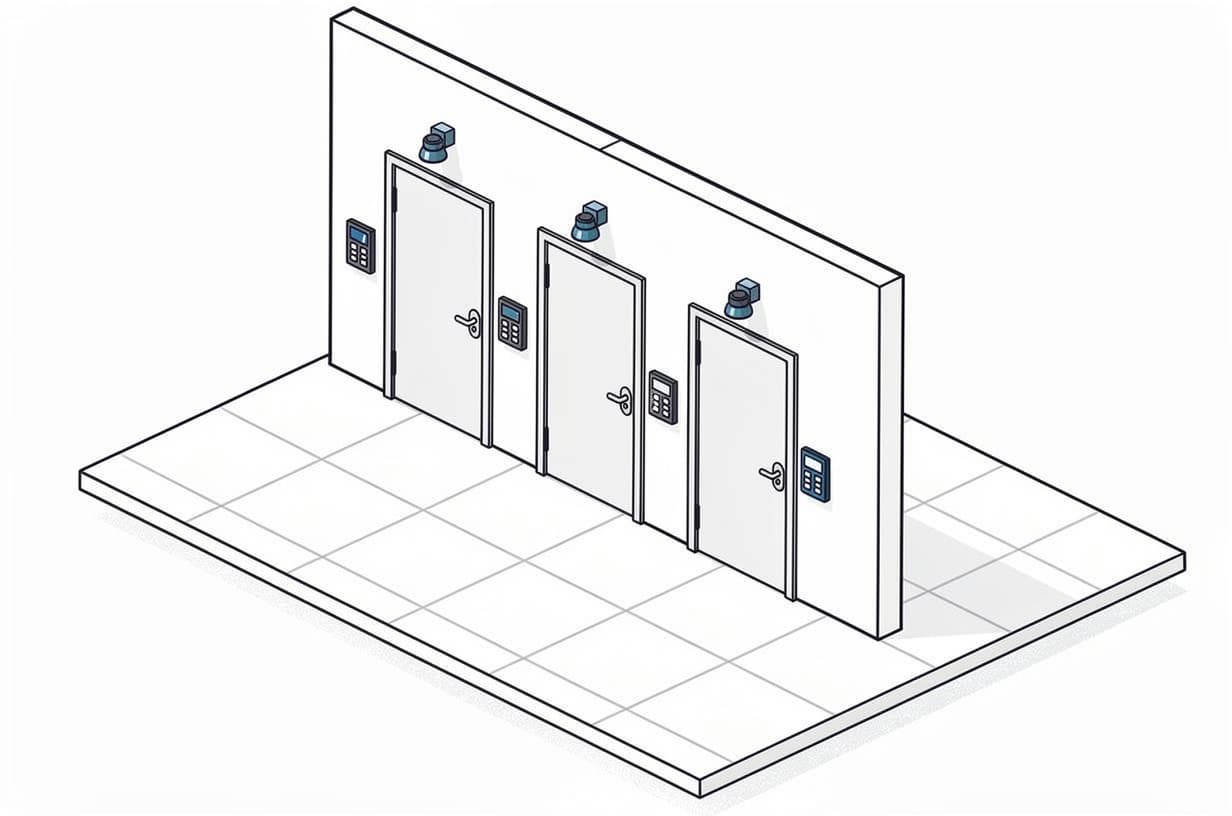
Table of contents
- Who shows up when you search access controls near me: three kinds of company
- When a national provider is right, and when a local integrator is
- Scope the job once, so every bid is comparable
- Reading three bids side by side: a 10-door, 16-camera office
- Screening before anyone gets your address
- Seven questions that separate bidders
- By building type
- Get it priced by more than one screened installer
- Frequently asked questions
If you are typing "access controls near me" into a search bar, you are probably at the point where somebody has handed you one number for a door and camera project and you cannot tell whether it is fair. This page is about fixing that: how to find the companies near you that install commercial access control and CCTV as one integrated security project, how to get two or three of them pricing the same doors and the same cameras, and how to read the bids side by side.
Commercial access control and CCTV are installed together by three kinds of company: national security integrators such as Johnson Controls, Securitas Technology (the former STANLEY Security), Everon (the former ADT Commercial), Convergint and Allied Universal Technology Services; regional integrators that cover one or a few states; and local licensed low-voltage or alarm contractors that specialize in commercial work. All three handle installation, cabling, programming and maintenance for access control and video surveillance on a single contract. Most buildings should have two or three of them quote the same scope before anyone signs.
Who shows up when you search access controls near me: three kinds of company
The three types are not interchangeable, and the differences matter more than the brand on the truck. The table below reflects the patterns we see across the quotes that come through our network; individual firms will differ.
| National integrator | Regional integrator | Local specialist | |
|---|---|---|---|
| Examples | Johnson Controls, Securitas Technology, Everon, Convergint, Allied Universal Technology Services | Multi-branch firms covering one state or region | Licensed low-voltage or alarm contractors with a commercial division |
| Typical building served | Multi-site portfolios, campuses, 40+ doors, enterprise platforms | 5 to 100 doors, single or several sites in one region | 1 to 40 doors, single site or a few local sites |
| Who comes to your site | Account manager, then a design engineer, then a field crew (sometimes subcontracted) | Sales engineer and an in-house crew | Often the owner or lead tech, who also does the install |
| Pricing transparency | Often a project total; per-door breakout on request | Often itemized by door and camera | Varies: some itemize, some give one lump sum |
| Typical contract term | Multi-year software, service and monitoring terms (36 to 60 months is common for monitoring agreements) | Shorter multi-year terms are typical | Month-to-month software to multi-year; sometimes install-only |
| Service response | Ticketed, SLA-based | Fast inside their footprint | Short travel time, often the same tech who did the install |
| Right answer when | Many sites, national standards, BMS or enterprise IT integration | Several buildings in one region, mid-size scope | One building, speed and price matter, you want to own everything |
When a national provider is right, and when a local integrator is
A national integrator is the right choice when you have multiple sites in multiple states, or a requirement to tie access control into an existing enterprise platform such as a building management system or a corporate identity directory. A local or regional integrator is the right choice for a single building, where the same scope often prices lower, the installer shows up faster, and you are more likely to own the hardware and the programming outright. Our rule of thumb from the scopes we see: one building under roughly 40 doors and 50 cameras, get local and regional bids; 40 sites in 12 states, go national.
That is not a knock on the national firms. If you run 40 sites in 12 states, one vendor, one standard and one service desk is worth paying for. But for a single 10-door, 16-camera building, the national quote often comes in highest, and it often arrives as a project total with the per-door math hidden inside. One more consideration for long contracts: ownership changes hands in this industry. ADT's commercial division became Everon after GTCR acquired it in October 2023, STANLEY Security became Securitas Technology after Securitas completed that purchase in July 2022, and Johnson Controls said in 2026 it is exploring options for parts of its security business (an announcement, not a completed sale). Ask every bidder, national or local, who will hold your service agreement in year four.
Scope the job once, so every bid is comparable
Buyers routinely end up with three quotes they cannot compare because they described the building three different ways. The fix is a one-page building profile that goes to every bidder unchanged:
- Door count by door type. Hollow metal, glass storefront or narrow-stile aluminum, wood, historic masonry, poured concrete, plus any gates, elevators or turnstiles. The door type drives labor more than anything else, which is why our access control installation cost guide prices standard openings and difficult openings separately.
- Existing door hardware. Which doors already have electric strikes, maglocks or closers, and which need new hardware. This is one of the largest hidden variances between bids.
- Camera count, interior versus exterior, with the areas each camera must cover (entrances, loading dock, parking, cash handling) rather than just a number.
- Retention window in days. 30 days is the usual commercial default; regulated industries often need 90 or more. Retention decides whether you are buying an on-premise NVR, cloud storage, or both.
- Credential type. Cards and fobs, mobile credentials, PIN, or a mix, and how many users on day one. (For what each credential type means and how OSDP differs from Wiegand, see our commercial access control systems page; you do not need to settle that to get comparable bids, but you do need every bidder quoting the same choice.)
- After-hours behavior. Whether doors are alarmed after hours and whether a forced-door event should trigger a monitored alarm or just a video bookmark.
- Network and cabling constraints. Whether there is an IDF closet near the doors, whether there are existing pathways or conduit, PoE switch capacity, and whether the system will sit on the corporate network or a dedicated VLAN.
- Who owns what afterward. State up front that you expect to own the hardware and hold the administrator credentials, so every bidder prices on that basis.
Everyone bids off that one document, so you describe the building once, not five times. It is also what our quote process is built around: one building profile, the same scope sent to up to three screened contractors, pricing back line for line.
Reading three bids side by side: a 10-door, 16-camera office
A comparable access control and camera bid must break out, at minimum: installed cost per door (hardware, door hardware changes, labor), installed cost per camera, network equipment, programming and training, per-door software licensing per month, cloud video storage per camera per month, any monitoring or service plan fee, first-year total versus ongoing annual cost, contract term, and who owns the equipment and software account at the end. If a bid gives you a project total without those lines, ask for them before you compare it to anything.
Commercial access control costs $1,500 to $3,500 per standard door installed, $3,000 to $5,000 all-in with first-year licensing, and $2,500 to $10,000+ for difficult openings, from glass storefront at the low end to gates, elevators and turnstiles at the top; cloud access software runs $3.50 to $15 per door per month. A standard commercial IP camera runs $500 to $900 installed (full range $300 to $1,500), and cloud video storage runs $10 to $30 per camera per month for 30-day retention. These are our published ranges as of October 2026; the detail behind them lives in our per-door cost guide and security camera installation cost guide.
Here is how three realistic bids on the same 10-door, 16-camera office building might land, using those ranges as the yardstick. The figures are illustrative.
| Line item | Bid A: national integrator | Bid B: regional integrator | Bid C: local specialist |
|---|---|---|---|
| Access control, 10 doors | $39,000 ($3,900/door, new strikes on all 10) | $29,000 ($2,900/door, new strikes on 6) | $24,000 ($2,400/door, reuses existing hardware) |
| Cameras, 16 | $16,000 ($1,000/camera) | $12,800 ($800/camera) | $10,400 ($650/camera) |
| Network, programming, training | $9,900 | $7,700 | $6,800 |
| Installed total | $64,900 | $49,500 | $41,200 |
| Access software | $12/door/mo = $120/mo | $7/door/mo = $70/mo | $4/door/mo = $40/mo |
| Video storage | Cloud, $25/camera/mo = $400/mo | On-premise NVR, $0/mo | Cloud, $15/camera/mo = $240/mo |
| Service plan | Included in term | $95/mo | None; time and materials |
| Recurring per month | $520 | $165 | $280 |
| Contract term | 60 months | 36 months | 12-month software subscription |
| Equipment ownership | Customer owns hardware; proprietary software platform | Customer owns all; admin credentials handed over | Customer owns hardware; cloud account sits under installer's dealer login |
| Five-year total | $96,100 | $59,400 | $58,000 |
Three things jump out once the bids are on one sheet. First, the $8,300 gap between B and C at installation nearly disappears over five years, because C's cloud video fees run on every month. Second, the per-door numbers are not comparing like with like until you account for door hardware: A's $3,900 lands above our standard-opening range precisely because every strike was replaced, C assumed the existing ones were reusable, and if four of those strikes fail inspection, C's per-door price moves toward B's. A per-door figure outside the published range is not wrong, but it needs an explanation before you compare it. Third, ownership is a line item. Bid C's cloud account living under the installer's dealer login is not necessarily a problem, but it is the thing that turns into one if you ever change providers, so it belongs in the comparison, not in a footnote.
This is also how you reconcile an installer who quotes per door against one who quotes a project total: divide the total by the door count and the camera count after pulling out the network and programming lines, and ask the lump-sum bidder to confirm your math. If they will not, that tells you something too.
Screening before anyone gets your address
To verify an installer before they quote, ask for the company's state license number and look it up on the issuing agency's public register, request a certificate of insurance (general liability and workers' compensation) sent directly from their insurer, and ask for two commercial references in your building type from the last 24 months. Confirm in writing who pulls the permit and who will hold the administrator credentials for the access and video software when the job closes.
The licensing point is not theoretical. In several states, including Illinois and Texas, installing commercial cameras is licensed alarm-contractor work, and in Illinois the same statute covers access control. Other states, Florida among them, draw the line differently, so confirm with the state board rather than assuming.
Illinois is explicit. The Private Detective, Private Alarm, Private Security, Fingerprint Vendor, and Locksmith Act defines an "alarm system" as "any system, including an electronic access control system, a surveillance video system, a security video system, a burglar alarm system, a fire alarm system," and a private alarm contractor as anyone who "undertakes ... or submits a bid to sell, install, design, monitor, maintain" those systems (225 ILCS 447/5-10). Any firm bidding your Chicago doors and cameras should hold an IDFPR Private Alarm Contractor license and an agency license, both checkable on the IDFPR license lookup. Chicago then adds a permit requirement and conduit rules that raise labor hours, which is why our Chicago video surveillance page prices the same camera higher than the national default.
Texas regulates the trade through the Department of Public Safety's Private Security program. Camera companies that transmit or store images need an Alarm Systems Company license, and individual technicians carry separate registrations, so you check the company and the person; our Houston page walks through both.
California splits the question: recording-only camera work falls under a CSLB low-voltage (C-7) or electrical (C-10) contractor license, and adding a monitored intrusion component brings in the Bureau of Security and Investigative Services alarm company operator license; see our Los Angeles page. Our city pages for New York, Dallas, Atlanta, Miami and Phoenix spell out the rule in each of those markets.
Insurance should be confirmed by certificate, not by the contractor saying so, and for a combined project ask to be named additional insured for the install. On permits, the question is usually "does the installer pull it, or does my electrician," and the answer changes the price. This is the checking we do before a contractor ever sees your scope: license verified against the state board, insurance confirmed by certificate, review and complaint history checked, and firms removed from our network if they generate complaints.
Seven questions that separate bidders
- Who owns the cabling and pathways? If the installer runs new cable, it stays with the building. If they install conduit or use existing pathways, get that in the scope so nobody bills for it twice.
- What does programming handover look like? You should leave the project with administrator credentials, a door schedule, and a user export. Ask for it in writing as a closeout deliverable.
- Who can revoke a badge at 6pm on a Friday? If the answer is "call our service desk," you do not control your own doors. You, or someone on your team, should be able to do it from the app in under a minute.
- Can we export the audit log? A door access control system for an office that cannot export who-badged-where to a spreadsheet is a problem the first time HR or an insurer asks who badged in.
- What is the PoE budget and headroom? Sixteen cameras plus ten door controllers need a switch with enough power budget for all of them and room to grow. Ask for the switch model and wattage.
- What are the warranty and service response terms? Parts, labor, remote support, on-site response time, and whether any of it requires a service contract to stay in force.
- What happens to the equipment and the account if we switch providers? You should own the readers, controllers, cameras and recorder outright, and the cloud account should be transferable to another dealer. If any part is leased or locked to a dealer portal, the bid needs to say so.
By building type
Finding commercial security systems companies that have actually worked in your building type comes down to one reference question: "Give me two jobs like mine in the last two years, and the facilities contact." Building-specific points for the scope:
- Multi-tenant office. Stairwell doors are a building-wide egress matter: they must either stay openable as code requires or unlock simultaneously from the fire command center. Tenant-suite doors and base-building doors often sit on different schedules. Our office building security guide covers the scope decisions.
- Warehouse and industrial. Dock doors, yard gates and the camera coverage of shipping and receiving drive cost. If you are in a CTPAT supply chain, deployed cameras bring documented footage-review obligations with them; see our warehouse and industrial guide.
- Schools. Lockdown function, visitor vestibules, and egress locks that release without a key, tool or special knowledge. Footage can be an education record under FERPA; our schools guide explains the retention and access implications.
- Clinics and healthcare. Cameras that can see a workstation screen pull the recorder into HIPAA scope. Privacy masking and controlled video access belong in the bid; details in our healthcare facilities guide.
- Retail. Sightlines, cash-handling coverage and identification-grade video matter more than camera count. Small chains often want one cloud video and access platform across stores; our retail guide covers the trade-offs.
- Multifamily. Resident credential management, intercom integration and turnover are the recurring costs. Some jurisdictions mandate self-locking entrances and intercoms; our multifamily guide has the specifics.
Get it priced by more than one screened installer
You can do all of this yourself: build the profile, find three commercial access control system companies, check three licenses, chase three certificates of insurance, normalize three quote formats. Or enter your ZIP code once on our quote request, and we send your single building profile to up to three contractors who are licensed in your state, insured by certificate, and experienced in your building type. The quotes come back on the same scope, with installed cost, recurring fees, contract term and equipment ownership visible side by side. The service is free to your business and always will be: the contractors pay us for the introduction, and we do not install, monitor or sell equipment, so we have no reason to steer you toward a higher number. For a buyer who searched "access controls near me" because one quote did not feel right, three comparable ones from screened local security system installers is the fastest way to find out.
Frequently asked questions
Which companies install commercial access control systems and CCTV together?
Three kinds of company do both on one project: national integrators such as Johnson Controls, Securitas Technology, Everon (formerly ADT Commercial), Convergint and Allied Universal Technology Services; regional integrators covering one or a few states; and local licensed low-voltage or alarm contractors with a commercial focus. All three handle installation, cabling, programming and maintenance for access control and video surveillance under a single contract.
Should I hire a national security integrator or a local access control installer for a 10-door, 16-camera building?
For a single 10-door, 16-camera building, a screened local or regional integrator is usually the better fit: comparable scope, lower installed cost, faster service response and a cleaner path to owning your own equipment and software account. A national integrator becomes the better choice when you have multiple sites, operations in several states, or a requirement to integrate with an enterprise platform.
How do I get more than one quote for a combined access control and camera project without describing my building five times?
Write a one-page building profile once (door count by type, existing hardware, camera count and coverage, retention window, credential type, network constraints, and the ownership you expect) and send the identical document to every bidder. Our quote service does this for you: one profile goes to up to three screened contractors so the quotes come back on the same scope.
How do I make two installers' bids comparable when one quotes per door and the other quotes a project total?
Ask the lump-sum bidder to separate network, programming and training from the door and camera work, then divide what remains by the door count and the camera count. Confirm both bidders are pricing the same door hardware changes, because new electric strikes versus reused hardware is the biggest source of per-door variance.
What should a per-door access control quote actually break out?
Each door line should show the reader and controller hardware, any door hardware changes (strike, maglock, closer, request-to-exit), cabling and labor, and the first-year software license. Separately, the quote should state the per-door monthly license after year one, which commonly runs $3.50 to $15 per door per month, and any monitoring or service plan fee.
Who handles the cabling, the door hardware, the programming and the permits when access control and cameras go in together?
On a combined project the integrator normally runs the cabling, installs or coordinates the electrified door hardware, and does the programming. Permits vary: the integrator pulls them in some jurisdictions, a licensed electrician in others, and a few cities require conduit for low-voltage work. Get all four responsibilities named in the bid.
How do I check that an access control installer is licensed and insured in my state before I let them quote?
Ask for the company's license number and verify it on the state agency's public lookup (for example, IDFPR in Illinois or the Department of Public Safety in Texas), then request a certificate of insurance for general liability and workers' compensation sent directly from the insurer. Our service performs both checks before a contractor receives your scope.
Do I own the readers, controllers, cameras and recorder after the install, or does the installer keep them if I leave?
In a standard purchase-and-install contract you own the hardware the day it is paid for, and the software account should be transferable to another dealer. Where a low monthly rate is subsidizing hardware, the provider often retains ownership, so read the ownership clause before signing and insist that the bid state who owns what at the end of the term.
Can access control and CCTV run on one platform and one app, or do they have to be separate systems?
They can run on one platform. Commercial access systems can integrate with video so a forced-door or denied-badge event pulls up the matching clip in one app. Separate systems still work, but ask every bidder to quote the integration explicitly so you are not comparing a unified platform against two unconnected ones.
How many doors and cameras do I need before a national provider is the better choice than a local integrator?
The threshold is less about the count at one building and more about the number of sites. Our rule of thumb: below roughly 40 doors and 50 cameras at a single site, a local or regional integrator often prices lower and responds faster. Multiple sites in multiple states, or a mandate to integrate with an enterprise platform, is where a national provider earns its premium.
What contract term and monthly fees should I expect on a combined access control and video project?
Expect cloud access software at $3.50 to $15 per door per month, cloud video storage at $10 to $30 per camera per month for 30-day retention (or $0 with an on-premise recorder), and an optional service plan. Terms range from month-to-month software subscriptions to multi-year agreements; commercial monitoring and service agreements commonly run 36 to 60 months, so compare five-year totals rather than installed price.
How do I find an installer who has actually worked in my building type?
Ask each bidder for two completed projects in your building type from the last two years, with a facilities contact you can call, and ask the reference about service response after the install. We screen contractors for building-type experience before matching them to a scope, so an office, warehouse, school, clinic or multifamily request goes to firms that have done that work.
Ready to get started?
Talk to our team and see how we can help.