Commercial Freezer Alarms and Environmental Monitoring: A Buyer's Guide
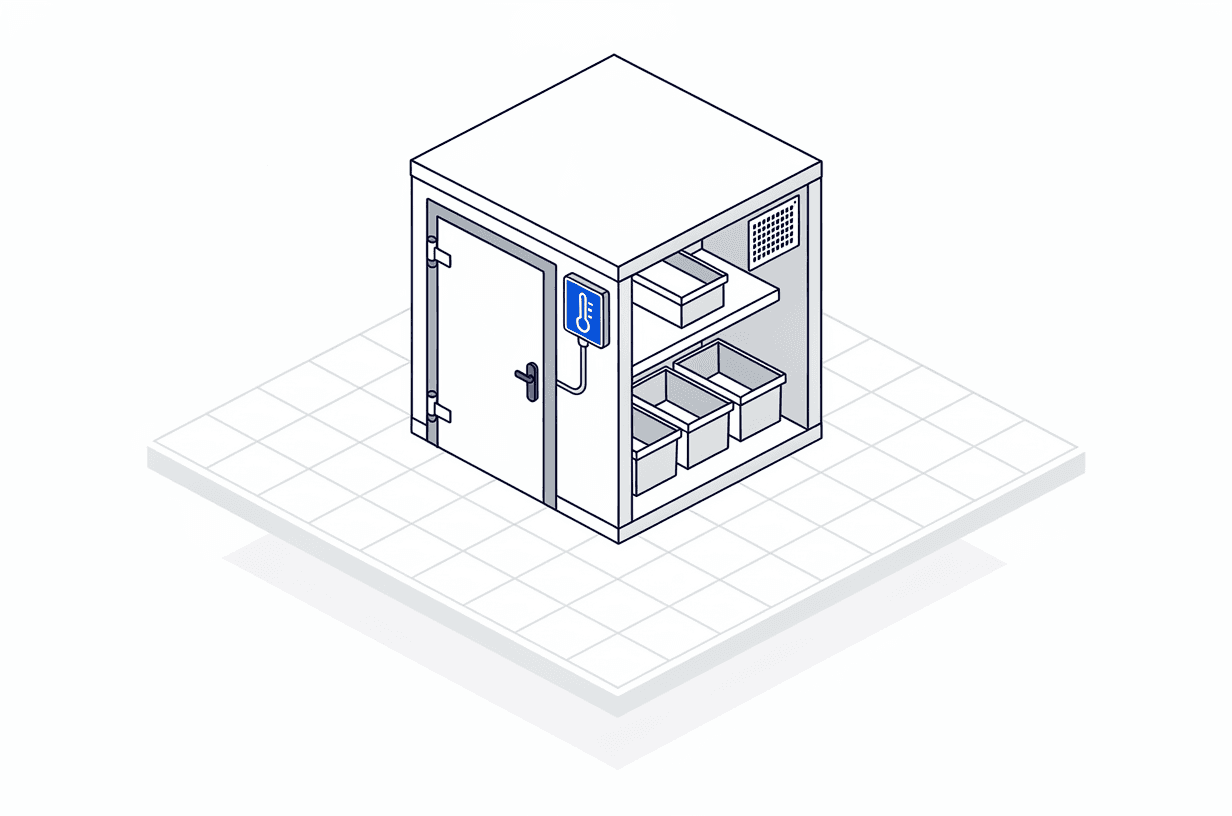
Table of contents
- Three ways an environmental alarm can reach you
- Walk-in freezer and refrigerator temperature alarms
- Commercial CO2 alarms for beverage systems
- Water-leak and flood sensors
- HVAC alarm monitoring
- How environmental sensors tie into a monitored alarm panel
- What environmental sensors add to a commercial alarm quote
- What to put in the scope before you ask for quotes
- Frequently asked questions
A commercial freezer alarm is only worth what happens after it trips. A buzzer on the walk-in door tells whoever is standing in the kitchen. A sensor on a monitored alarm panel tells a staffed central station at 2 a.m. on a Sunday, and an operator works your call list until a person answers. The same is true of refrigerator, CO2, water-leak and HVAC alarms: the sensor is the cheap part, and the routing decides whether you save the inventory.
This guide covers what each environmental sensor does, the setpoints and code requirements behind them, how they connect to a commercial alarm panel, and what they change on an alarm quote. We don't install or monitor any of this equipment. We scope projects and match businesses with licensed contractors, so what follows is written from the buyer's side of the quote.
Three ways an environmental alarm can reach you
Before comparing sensors, decide which of these you are buying.
| Approach | Who gets the alert | Where it fits | Main weakness |
|---|---|---|---|
| Local alarm (buzzer and light at the unit) | Anyone within earshot | Door-ajar and entrapment alerts during business hours | Nobody hears it when the building is empty |
| Standalone cloud sensor (Wi-Fi or cellular, app alerts) | Whoever has the app, by push, text or email | Temperature logging for health inspections, low hardware cost | Depends on someone noticing a phone notification; no operator follows up |
| Sensor on a monitored alarm panel | A 24/7 central station, then your call list | Losses that happen overnight: freezer failure, leaks, freeze-ups | A threshold alarm, not a temperature log |
These are not mutually exclusive. A restaurant can reasonably run a cloud logger for its HACCP records and a panel-connected sensor for after-hours response. The mistake is assuming one does the other's job.
Walk-in freezer and refrigerator temperature alarms
A commercial freezer temperature alarm is a probe inside the box wired or radioed to something that acts when the reading crosses a threshold for long enough. Three numbers matter when you set it up.
- Refrigeration limit: 41°F. The 2022 FDA Food Code (§3-501.16) requires time/temperature control for safety food to be held at 41°F or below. Your state or county adopts its own version, so confirm the local figure.
- Freezer target: 0°F. FDA storage guidance puts freezers at 0°F (-18°C).
- The clock after a failure. FoodSafety.gov says a closed refrigerator keeps food safe for up to 4 hours without power, after which perishables should be discarded. A full freezer holds for about 48 hours with the door shut (24 hours if half full). A reach-in refrigerator that fails at closing time is past the 4-hour mark long before the opening shift arrives.
That last point is the business case for a commercial refrigerator alarm that reports off site. A failure after closing has hours to do damage before anyone opens the door. It is why our small-business security guide recommends high/low temperature sensors on restaurant walk-ins.
Setpoints, delays and probe placement
Temperature alarms use a delay so that a brief rise, from a door opening or a defrost cycle, does not trigger a call. Check what the device actually does before you rely on it. The Honeywell 5821, a wireless sensor for Honeywell panels, alarms when a freezer stays above 10°F for more than 30 minutes or a refrigerator stays above 42°F for more than 30 minutes. Those are the device's published alarm points, and 42°F sits a degree above the Food Code limit. That is fine for catching a dead compressor. It will not prove compliance to an inspector.
Programmable monitors give you more control. The Winland EnviroAlert EA200, for example, reads from -58°F to 302°F with sensor cable runs up to 1,000 feet and gives each zone its own relay output. Its manual is explicit that the console does not go inside the cooler or freezer. Only the remote probe does. Ask the installer where the probe will sit and why.
One caution for clinics and pharmacies. A panel alarm does not replace the recording device vaccine programs require. CDC's storage guidance sets refrigerators at 2°C to 8°C and freezers at -50°C to -15°C, and state Vaccines for Children programs such as New Jersey's require a digital data logger on each storage unit. The monitored alarm is the layer that wakes someone up. The logger is the record.
Commercial freezer door alarm and entrapment alarms
A commercial freezer door alarm is a magnetic contact that sounds when the door has been open too long. It is an energy and product-loss device, and it works well as a local alarm because the person who left the door open is usually nearby.
Entrapment alarms are a separate matter. A walk-in monitor such as the Imperial Brown Modularm 75LC combines temperature, door-ajar, AC-failure and panic alarms, with an optional illuminated push button inside the box. A panic button supplements the inside door release. It does not replace it. Where a door serves as an exit route, OSHA's 29 CFR 1910.36(d) requires that employees can open it from the inside at all times without keys, tools or special knowledge.
Imperial Brown walk-in alarm kits and monitors
If you are replacing or specifying an Imperial heavy duty commercial freezer alarm, Imperial Brown makes two relevant items. One is an OEM replacement alarm kit for the company's walk-in coolers and freezers (part IBTHKIT50870), which parts distributors list at roughly $180 to $242 ($239.86 at Parts Town). The listings do not say whether it has a remote output. The other is the Modularm 75LC monitor described above.
The detail to check on any unit of this type is the output. The 75LC has a built-in sounder plus normally-open and normally-closed dry contacts, and Imperial Brown's documentation notes that remote notification needs additional equipment. Those dry contacts are what an alarm contractor wires to a 24-hour zone on your panel, turning a local buzzer into a monitored signal. If a door-mounted alarm has no relay output, it can only ever be local.
Commercial CO2 alarms for beverage systems
A commercial CO2 alarm is a life-safety device first and a code item second. CO2 for soda and beer is heavier than air, so a leak collects near the floor and in below-grade rooms. In 2011 a leaking gas line at a Georgia McDonald's sickened ten people and killed one after a leaking line inside the walls let CO2 build up.
The requirements come from the fire code, not the alarm industry:
- Trigger quantity. Section 5307.3 of the 2021 International Fire Code applies to insulated liquid CO2 systems holding more than 100 pounds used for beverage dispensing. Rooms with those systems need either ventilation or a gas detection system.
- Sensor height. Detectors go within 12 inches of the floor, where the gas accumulates.
- Two alarm levels. Where gas detection is used, IFC §5307.3.2 requires an audible and visible supervisory alarm at a normally attended location at 5,000 ppm, and an audible and visible alarm in the room itself at 30,000 ppm. Loveland Fire Rescue Authority's handout for beverage CO2 systems shows how one fire department applies it. The lower figure matches OSHA's permissible exposure limit of 5,000 ppm as an 8-hour average.
Which edition applies, and whether smaller cylinder setups are covered, depends on your fire marshal. Ask before you buy.
Purpose-built units for this job include the Analox Ax60+ (listed at about $795 for the base package) and CO2Meter's remote storage safety alarm at about $695. Both are standalone CO2 safety monitors. Connecting one to your alarm panel adds an off-site signal, but the audible and visible alarm the code requires at the room still has to work on its own. Don't confuse any of this with carbon monoxide detection, which is a different gas, a different sensor and a different zone type.
Water-leak and flood sensors
A water sensor is two contacts that close when water bridges them. It is the simplest device in this guide, and one probe covers the spot where an expensive leak starts. Typical locations:
- Under water heaters and beside mop sinks
- In the drain pan of rooftop and ceiling-mounted air handlers
- Below sprinkler risers and backflow preventers
- On the floor of server and telecom rooms
- Behind ice machines and dish machines
- At the low point of any basement or below-grade storage
Hardware is modest. A Winland WaterBug WB200 with a relay output retails around $83 and can supervise up to six probes. The wireless Honeywell 5821 mentioned earlier doubles as a flood detector with a short probe lead, alarming after the probe has been wet for more than three minutes.
A sensor reports a leak. It does not stop one. If the exposure is a supply line above finished space or stock, ask contractors whether an automatic shutoff valve belongs in the scope, and who installs it, since that is plumbing work.
HVAC alarm monitoring
HVAC alarm monitoring means using the alarm panel to report conditions the mechanical system causes or fails to prevent. In practice that is four signals:
- High temperature in server rooms, IT closets and pharmacies when cooling fails
- Low temperature anywhere pipes can freeze when heat fails over a holiday weekend
- Humidity out of range in archives, labs and grow rooms
- Condensate overflow, taken from the float switch in a drain pan
One low-temperature signal is different from the rest. Sprinkler riser and fire pump rooms have to stay above 40°F, and where a room temperature switch is installed, NFPA 72 treats it as a supervisory signal on the fire alarm panel that trips at 40°F. MeyerFire's review of the standards notes the sprinkler codes require the room to be kept warm without clearly mandating the switch. If you have one, it belongs in the fire alarm scope, not on the burglar panel.
If the building has a management system, the alarm panel does not need to duplicate it. A dry contact from the BMS or the unit controller can feed a monitored 24-hour zone, so a critical alarm reaches the central station when nobody is watching the BMS screen. Environmental monitors such as the Winland EA800-ip also accept dry-contact and 4-20mA inputs.
How environmental sensors tie into a monitored alarm panel
There are two wiring patterns. A wireless transmitter is enrolled directly as a zone on the panel. Or a dedicated environmental monitor reads the probes and closes a relay that the panel sees as a zone. The second gives you adjustable setpoints and a local display, which matters in commercial kitchens and cold storage.
Either way, the zone type is what makes it work. Environmental sensors go on 24-hour zones that report whether the system is armed or disarmed, a point we cover in our intrusion detection system explainer. On a Honeywell Vista panel that is zone type 08, 24-hour auxiliary, which reports to the central station and sounds the keypad without triggering the siren. DSC PowerSeries Neo panels have dedicated 24-hour flood, high-temperature and low-temperature types, and Bosch panels handle them as non-fire 24-hour points. A temperature sensor programmed as an ordinary burglary zone will sit silent all day while the system is disarmed.
Alert routing: what the central station does
Environmental signals do not send police or fire. Each event arrives with its own code (the Contact ID format has separate codes for refrigeration, water leakage, high temperature and low temperature), and the operator follows a notification procedure. One state alarm-monitor training manual describes it this way: call the premises, then the emergency list, and keep trying until someone is notified.
That makes the call list the part you control. Get these right at installation:
- Label every zone specifically. "Walk-in freezer high temp" tells the operator and your manager what to do. "Zone 14 aux" does not.
- Build a separate call list for environmental zones. The person who should hear about a warm freezer is often the chef or the refrigeration contractor, not the keyholder for burglar alarms.
- Add a power-failure signal. A panel on battery backup with a cellular path keeps reporting during the outage that is warming your cooler. Our guide to cellular alarm communicators covers the options.
- Ask for app or text alerts in parallel. Platforms such as Alarm.com Commercial can push the same event to phones. Use that as a second route alongside the operator call, which is part of what you pay for in business alarm monitoring.
- Test it. Warm the probe or wet the sensor during commissioning and confirm who gets the call.
What environmental sensors add to a commercial alarm quote
When environmental sensors are added to an intrusion system that is already being installed, they are a small line item. The panel, communicator and monitoring account already exist. Our commercial alarm system cost guide puts a small storefront system at $1,500 to $4,000 installed and notes that water and temperature sensors get added where they would save an insurance claim.
We don't publish an installed price range for environmental sensors. Our intrusion explainer describes them only as low cost per device. What we can give you are the inputs a contractor prices from.
| Line item | Reference figure | What moves it |
|---|---|---|
| Wireless temperature/flood transmitter | About $50 to $70 retail hardware (Honeywell 5821) | Panel brand compatibility; a T280R probe is needed for refrigerator and freezer use |
| Two-zone environmental monitor with relays | About $130 to $185 retail hardware (Winland EA200) | Number of boxes monitored; probe type |
| Water sensor with relay | About $83 retail hardware | Number of probes and distance between them |
| CO2 detection system | About $700 to $850 retail hardware | Number of sensors and remote strobes the fire marshal requires |
| Cable run to the panel | $150 to $300 per drop in an occupied building (our cost guide) | Penetrating insulated walk-in panels, ceiling access, distance |
| Low-voltage labor | $75 to $150 per hour | Programming zones, central station setup, testing |
| Zone expansion | Varies by panel | Whether the existing panel has spare zones |
Hardware figures are retail listings at the time of writing. A contractor's price will include markup, labor and warranty, so expect the installed number to be well above the part cost.
What it does to the monthly bill
Often very little. Basic commercial intrusion monitoring runs $30 to $75 a month in our published ranges, and environmental zones report over the same communicator to the same account. Some providers include them. Others charge a small add-on: one dealer's published Alarm.com commercial price sheet lists water management at $2.50 a month. Ask each bidder to state the figure, because it is an easy place for an unexplained recurring charge to appear.
For comparison, a standalone cloud sensor can cost less still. SensorPush's Wi-Fi gateway is $99.95, sensors extra, with cloud service included and no monthly fee. You get a temperature history and phone alerts, and no operator. Restaurant-focused compliance platforms sit at the other end, with subscriptions that bundle logging, checklists and reporting.
Contract points that matter more than the sensor price
- Term. Adding a sensor to an existing account should not restart a 36- or 60-month agreement. Read the change order. Our monitoring contract scorecard covers renewal and exit terms.
- Ownership. Confirm the sensors and any environmental monitor are yours, and that they are not proprietary to one dealer.
- What the alarm is not. A monitored freezer alarm reduces the odds of a loss. It is not spoilage insurance. Ask your broker separately whether your policy covers spoilage and equipment breakdown.
- Service. Probes fail and batteries die. Ask who replaces them, at what trip charge, and whether the zone is supervised so a dead sensor reports as a trouble.
What to put in the scope before you ask for quotes
Quotes are only comparable when every bidder prices the same scope. Give each one the same list:
- Each cold box by type and location, with the setpoint and delay you want
- Whether you need a temperature record for inspections or only an alarm
- The CO2 system type and quantity, and what your fire marshal has told you
- Each leak point you want covered
- Existing panel make and model, and whether it has spare zones
- Who should be called for each type of alarm, in order
With that list in hand, quotes come back comparable line by line. That is how our process works: you describe the project once, we send the same scope to contractors whose state license and insurance we have verified, and you compare installed cost, monthly rate, term and equipment ownership side by side. It is free to the business, and there is no obligation to hire anyone. How it works has the detail.
Frequently asked questions
Will the alarm company send someone when my freezer alarm goes off?
Not by default. Temperature and water signals are handled by notification: the central station calls the premises and then your emergency contact list until someone answers. Police and fire are not dispatched for environmental alarms. Some providers offer a paid guard response if nobody on the list can be reached.
What temperature should a commercial freezer alarm be set to?
Freezers are held at 0°F, so alarms are set some margin above that with a delay so brief rises do not trigger a call. The Honeywell 5821, for example, alarms at 10°F sustained for 30 minutes. For refrigerators, the Food Code limit is 41°F, so the alarm should trip at or just above that after a similar delay. Set the exact figures with your refrigeration contractor.
Is a CO2 alarm required for a restaurant soda system?
Under the 2021 International Fire Code, insulated liquid CO2 systems over 100 pounds used for beverage dispensing need either ventilation or gas detection in the room where they sit. Whether your setup is covered depends on the code edition your jurisdiction has adopted and on local amendments. Your fire marshal is the authority.
Can environmental sensors be added to an alarm system we already have?
Usually, yes. If the panel has a spare zone or accepts a zone expander, a contractor can add a wireless transmitter or wire in the relay output of an environmental monitor, then program it as a 24-hour zone. Check first that your equipment is not locked to the original dealer.
Do temperature sensors on an alarm panel satisfy health inspection records?
Generally not on their own. Panel sensors such as the Honeywell 5821 report when a threshold is crossed. They are not data loggers. If you need logged readings for HACCP records or a vaccine program, pair the monitored alarm with a data logger or a cloud logging sensor.
Ready to get started?
Talk to our team and see how we can help.